TikTok account takedown in 2026: DMCA, impersonation, and when to use a service
A TikTok account takedown is the formal removal of a TikTok account, or its content, through TikTok's own legal and policy channels — primarily the Copyright Infringement Report (a DMCA notice), the impersonation report, and the trademark report. Each route serves a different harm; each has its own timeline. Clean filings often resolve within 24–72 hours.
Dealing with a fake or content-thief TikTok account?
Send us the profile link and what was copied or impersonated — we'll prepare the right TikTok takedown notice through official channels.
We never ask for passwords · Legitimate owners & genuine victims only · No guaranteed outcomes
A TikTok account takedown removes an infringing or impersonating account through TikTok's own forms: DMCA copyright (the strongest legal route), impersonation, trademark, or scam reports. The route you pick decides outcome speed — and whether the whole account survives, not just the offending video.
- What a TikTok account takedown is
- When TikTok actually removes an account
- DMCA takedown TikTok: step by step
- What every copyright notice must contain
- DMCA vs. impersonation: which route
- After the takedown: counter-notices & strikes
- EU options: DSA, ODS, national DPAs
- When a takedown service helps
- What we will and won't do
What is a TikTok account takedown, exactly?
A TikTok account takedown is the platform-level removal of an account or its content because that account has broken one of TikTok's enforceable rules: copyright infringement, trademark misuse, impersonation, scam behaviour, or other Community Guidelines violations. It is not the same as tapping Report on a single video.
An in-app report flags content to TikTok's general moderation queue. A takedown is a structured filing — usually one of three official forms — that asserts a specific policy or legal violation and demands action. Copyright reports operate under the U.S. Digital Millennium Copyright Act (DMCA), 17 U.S.C. §512. Trademark and impersonation reports operate under TikTok's Intellectual Property Policy and Community Guidelines.
The difference matters because it determines which TikTok team reviews it, what evidence is required, and what TikTok is legally obliged to do when the filing is valid. For copyright in particular, TikTok must act on a properly formatted notice to keep its safe-harbour protection. That is leverage no in-app report carries.
When TikTok actually removes an account — and when it doesn't
TikTok removes accounts when the violation is specific, well-evidenced, and matches a category TikTok actively enforces — copyright infringement, trademark misuse, impersonation that causes user confusion, coordinated scam behaviour, non-consensual intimate imagery, and threats to minors. Volume of reports does not drive removal. Quality of the filing does.
TikTok has publicly documented removals of accounts impersonating high-profile creators including Khaby Lame and Charli D'Amelio, where copycat profiles used identical photos and attempted to funnel followers off-platform to scams. The same enforcement pattern applies to far less famous accounts when the filing is clean. Independent reviewers of 2025–2026 enforcement note that TikTok responds most reliably to copyright and trademark assertions when those are properly substantiated.
What TikTok will not remove, regardless of how many people report it: lawful criticism, parody clearly labelled as parody, accounts with merely similar names that don't cause confusion, fan accounts that disclose they are unofficial, and reviews or commentary protected as fair use or fair dealing. If those are your case, the takedown route is not the right tool — and we will say so.
DMCA takedown TikTok: how to file step by step
A DMCA takedown on TikTok is filed through one form — the official Copyright Infringement Report — one report per infringing URL. The form walks you through identity, ownership proof, the infringing link, and a sworn statement. TikTok typically issues a decision within 24–72 hours when the notice is complete and valid.
The DMCA takedown TikTok rights holders rely on isn't anonymous. The statute requires your name and contact details inside the notice, and TikTok forwards those to the uploader if a counter-notification is filed. Many rights holders therefore file through an authorised agent — a designated representative whose details appear in the notice instead — which is one of the services we provide.
- Gather your evidence. The link to your original work, the exact URL of each infringing video, side-by-side screenshots with timestamps, and proof of ownership (registration certificate, raw files, publication date, contracts).
- Open the form. Go to
tiktok.com/legal/report/Copyrightor, in the app, tap Share → Report → Intellectual property infringement. - Verify your email and identity. TikTok will email a verification code. State whether you are the rights holder or an authorised agent.
- Describe the work and the infringement. Upload ownership documentation; paste each infringing URL; explain in one or two sentences what was copied and how you know.
- Make the two sworn statements. Good-faith belief the use is not authorised; accuracy under penalty of perjury.
- Request future-copy prevention (optional but worth doing). When approved, TikTok blocks identical re-uploads of the same video via content matching.
- Submit and keep the confirmation. The reference number is your receipt for follow-up.
A common cause of rejection isn't a weak case — it's a missing element. Skip the §512(c)(3) fields and even a strong infringement claim gets bounced as procedurally invalid. That checklist is next.
What every TikTok copyright takedown notice must contain
A valid TikTok copyright takedown notice has six fields the statute requires, set out in 17 U.S.C. §512(c)(3). TikTok's form maps to each. Omit one and the notice can be thrown out, regardless of how clear the infringement is. The two sworn statements at the end are not boilerplate — knowingly false ones carry liability under §512(f).
- 1. Signature. Physical or electronic, of the rights holder or an authorised agent.
- 2. Identification of the copyrighted work. What was infringed, with enough detail to evaluate it (title, registration number, the original URL).
- 3. Identification of the infringing material. The specific TikTok video URL — one notice per URL is the safest convention.
- 4. Contact details. Address, phone, email of the filer. These are forwarded to the uploader if they counter-notify.
- 5. Good-faith statement. "I have a good-faith belief that the use of the material is not authorised by the copyright owner, its agent, or the law."
- 6. Accuracy & authority statement. "Under penalty of perjury, the information is accurate and I am authorised to act for the owner."
A knowingly false DMCA notice can expose the filer to damages, costs, and attorneys' fees under 17 U.S.C. §512(f). Courts have applied this. This is exactly why a credible takedown service confirms ownership before drafting, and why we will refuse to file a notice we can't stand behind.
The most common reasons we see TikTok copyright takedown reports rejected, based on our 2026 caseload: filing under copyright when the issue is trademark or impersonation (wrong route), no documentary proof of ownership when the work isn't already published in the filer's name, a URL that points to the wrong video, or a single notice batching unrelated infringements. Fix the procedural defect and a refile usually succeeds.
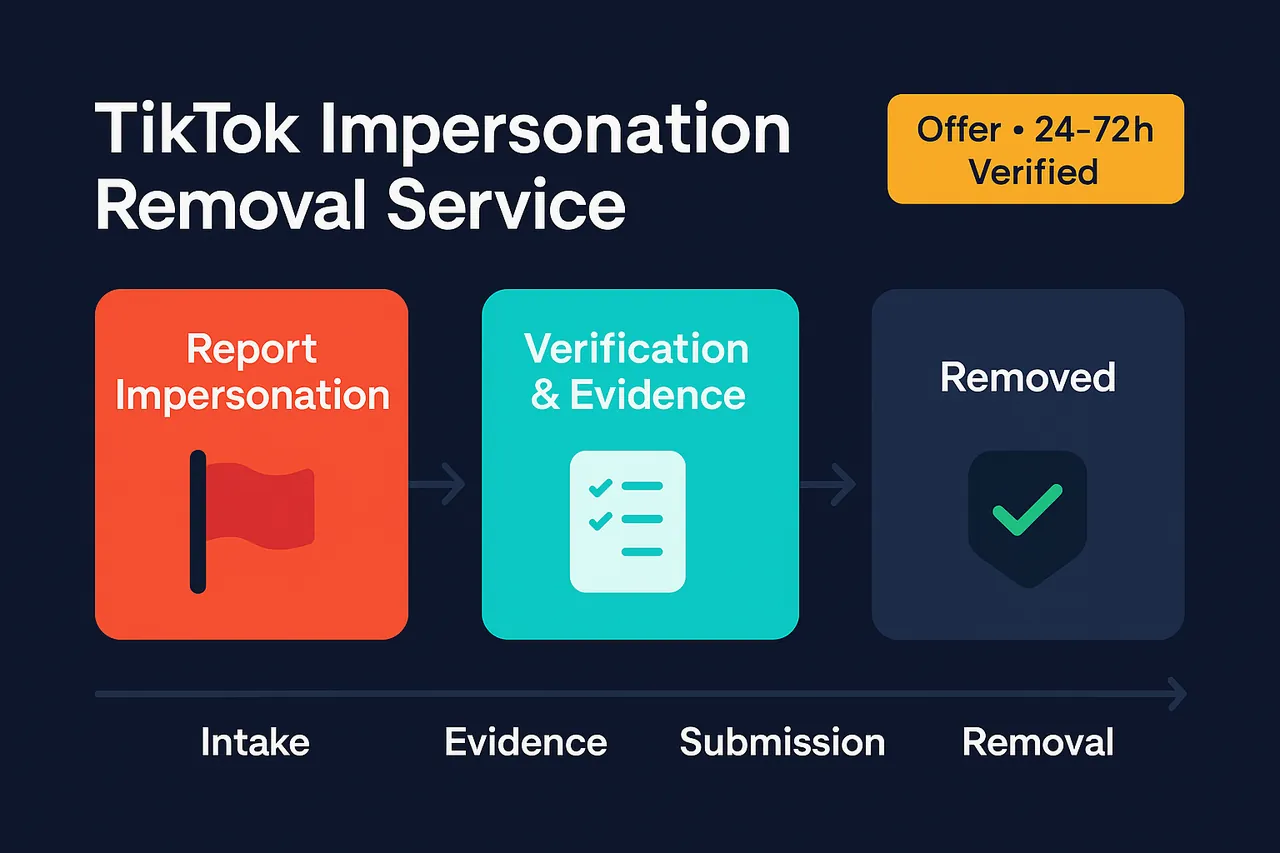
TikTok DMCA takedown vs. impersonation report: which route to choose
Picking the wrong route is the single biggest reason a TikTok DMCA takedown or impersonation report gets rejected on a case that should have won. Copyright covers stolen content; impersonation covers stolen identity; trademark covers stolen brand assets. They are handled by different review teams, evaluated against different rules, and have different timelines.
Use this matcher to map your case to the route TikTok actually actions, with the typical timeline and strength we see in 2026:
| Your case has | Best TikTok route | Typical timeline | Strength |
|---|---|---|---|
| Stolen video, photo, song, or sound | DMCA Copyright Infringement Report | 1–5 business days | Strong — legal force under §512 |
| Fake profile using your name & photos | Impersonation Account Report | 3–7 days | Medium — needs photo ID |
| Misuse of your registered logo | Trademark Infringement Report | 2–5 days | Strong — legal force |
| Scam DMs or fake "shop" using your brand | Trademark + Scam report | 5–10 days | Medium — depends on evidence |
| Counterfeits in TikTok Shop | IP & Brand Protection programme | Priority pathway | Strongest — direct enforcement |
| Non-consensual intimate imagery | Privacy report + StopNCII.org hash | 24–72 hours | Strong — proactive blocking |
Cases often overlap. A fake creator account using stolen videos, your registered name, and a phishing link in the bio is impersonation and copyright and scam — and the strongest filing route is usually copyright, because it carries legal weight the others don't. For platform-side cousins of this routing logic, see our Instagram account takedown guide and Telegram account takedown walkthrough — the principles transfer.
What happens after the takedown: counter-notices, strikes, and account termination
Once TikTok actions a takedown, three things can happen. The uploader can accept it. The uploader can submit a counter-notification under §512(g). Or the uploader can simply create a new account and re-upload — which is when one notice becomes a campaign. Understanding each path keeps the removal from quietly reversing.
A counter-notification gives the uploader a route back. If TikTok accepts it as procedurally valid, the platform tells the original filer and forwards the uploader's contact details. The filer then has 10 business days to either accept the reinstatement or file a court action seeking an order to keep the content down. Miss the window and the content reappears.
Repeat infringers are different. TikTok doesn't publish an exact threshold, but in practice three copyright strikes within a 90-day rolling window typically end an account. Strikes individually expire after 90 days, so an infringer who paces re-uploads can avoid termination — which is why scaling enforcement matters more than filing once. Tracking which account is on its second strike, and which strike falls off next week, is part of what a sustained brand-protection programme does.
EU options if your TikTok takedown gets denied (DSA, ODS, national DPAs)
If your TikTok takedown is denied or ignored and you're in the EU, the Digital Services Act (DSA) gives you three routes most rights-holder guides skip. The first is the DSA's notice-and-action mechanism — a statutory complaint that VLOPs like TikTok must process, with a reasoned decision and an appeal path.
The second is the route almost no competitor article mentions: an Out-of-Court Dispute Settlement (ODS) body. Since the DSA came into force, certified ODS bodies — including Appeals Centre Europe and Malta-based ADROIT — review TikTok, Meta, Pinterest, and YouTube moderation decisions independently. Filing is usually free for the user; if the body finds for you, the platform pays the fees. Decisions aren't binding on TikTok, but in our 2026 cases a contested decision flagged for ODS review often gets reconsidered before it gets there.
The third route is your national Data Protection Authority where the case involves personal data — France's CNIL, Germany's BfDI, the UK's ICO, Spain's AEPD, Italy's Garante, Ireland's DPC (which is TikTok's lead EU regulator under GDPR). The GDPR Article 17 right to erasure is the relevant legal basis when the takedown concerns identifiable personal data. For platform-side parallels of this escalation logic, our X/Twitter abuse-route breakdown and X reporting guide walk through the equivalent processes.
When a TikTok takedown service helps — and when DIY is enough
A TikTok takedown service earns its place when the case is bigger than one form. A single infringing video and a clear case — that's a DIY job, and we'll tell you so. Where a service genuinely adds value is on scale, on procedural correctness, on the counter-notice clock, and on filer privacy.
Hand the case to a service when: a video gets re-uploaded across dozens of new handles, a seller pushes counterfeits across multiple shop listings, your footage has been edited and monetised on accounts you can't keep track of, a valid notice was wrongly rejected and needs a clean refile, or you're an individual creator who doesn't want a hostile uploader receiving your home address through the §512(c)(3) contact field.
What a credible TikTok takedown service does, and what it never does: it confirms you hold the rights, matches each infringement to the correct official channel, drafts notices that satisfy §512, files through an authorised-agent route to keep your address off the form, watches the 10-day counter-notice window, and refiles when uploads return. What it never does is move against a legitimate account or fabricate a claim. If the case is spam, fake engagement, or scam-account suppression rather than copyright, that runs through a different process — see our notes on TikTok mass-report bots and the TikTok ban-service category for how that side actually works.
Stuck in a rejection loop or watching re-uploads come back? A refile with the right legal basis usually clears it. Send us the case and we'll review honestly before we file anything.
What we will and won't do on TikTok
We file real TikTok takedown notices, on real evidence, for the actual rights holder or genuine victim. We do not run mass-reporting campaigns against lawful accounts. We do not target speech we disagree with. We do not promise outcomes — every removal rests with TikTok's independent review.
We never ask for your TikTok password or two-factor code. We file from a documented agent address, not yours, when you want anonymity. We say so when a case is weaker than you think it is, and we recommend DIY when DIY is the right call. That's the operating standard you'll see across our Copyright & IP Takedown, Impersonation Removal, and Scam & Fraud Reporting services, and on every related guide we publish — including the recovery playbook for hacked Instagram accounts.
Frequently asked questions
How long does a TikTok account takedown take?
TikTok says most valid Copyright Infringement Reports get a decision within a few business days, sometimes within 24 to 48 hours when documentation is clean. Impersonation reports usually take 3 to 7 days from our 2026 caseload. Complex cases with counter-notifications, or accounts that re-upload under new handles, can run longer.
Can I file a DMCA takedown on TikTok from outside the United States?
Yes. TikTok accepts copyright reports from rights holders worldwide. The DMCA is a US statute (17 U.S.C. §512), but TikTok applies its copyright policy globally and considers equivalent national laws — the EU Copyright Directive Art. 17 and the UK Copyright, Designs and Patents Act, for example. The same Copyright Infringement Report form is used.
What's the difference between a TikTok DMCA takedown and an in-app report?
An in-app "Report" flags a Community Guidelines issue — harassment, spam, misinformation, scam behaviour. A TikTok DMCA takedown is a formal legal notice under 17 U.S.C. §512 that the platform must process to preserve safe-harbour status. They go to different teams and carry different consequences. Use the DMCA form only for actual copyright infringement.
Can the person I reported reverse the takedown?
Yes — through a counter-notification. After TikTok removes content under a DMCA notice, the uploader can submit a §512(g) counter-notice. If TikTok accepts it and no court action is filed within 10 business days, the content is reinstated. The takedown filer's contact details are forwarded to the uploader, which is one reason rights holders often file through an authorised agent.
How many copyright strikes can a TikTok account get before it's terminated?
TikTok doesn't publish an exact number, but in practice three copyright strikes within a 90-day rolling window usually triggers a permanent ban. Individual strikes expire after 90 days. The penalty escalates: first violation often a warning + removal, second can mute audio or restrict features, third typically ends in account termination.
Is a TikTok takedown service the same as a mass-report service?
No — and the distinction matters. A legitimate TikTok takedown service files real, evidence-backed notices under copyright, trademark, or impersonation rules — for the actual rights holder. "Mass-report" or coordinated-reporting services try to suppress lawful accounts by gaming the report queue. We do the first; we refuse the second.
How much does a TikTok account takedown service cost?
There's no flat platform fee — TikTok's own forms are free. Service cost depends on scope: a single notice for one infringing video is far cheaper than monitored brand protection tracking re-uploads across hundreds of handles. We quote per case after seeing the details, never with flat pricing — vague pricing tends to hide vague work.
Can I file a TikTok account takedown anonymously?
Not entirely. DMCA notices require the filer's name and contact details inside the notice itself (§512(c)(3)), and TikTok forwards them to the uploader if a counter-notification is filed. The standard workaround is to file through an authorised agent — a representative whose contact appears on the notice instead of yours. That keeps your address private without breaking §512.