TikTok Ban Service: What Actually Works (2026)
A TikTok ban service is a managed, evidence-led reporting workflow that documents an abusive account's Community Guidelines violations and files them through TikTok's official channels — in-app, web, and dedicated impersonation, copyright, and trademark forms — until the rule-breaking account is restricted or permanently removed.
Need a fake or abusive TikTok account taken down?
Send us the profile link and what's been done to you — we'll check the evidence and tell you honestly if it's something TikTok will action.
We never ask for passwords · Legitimate owners & genuine victims only · No guaranteed outcomes
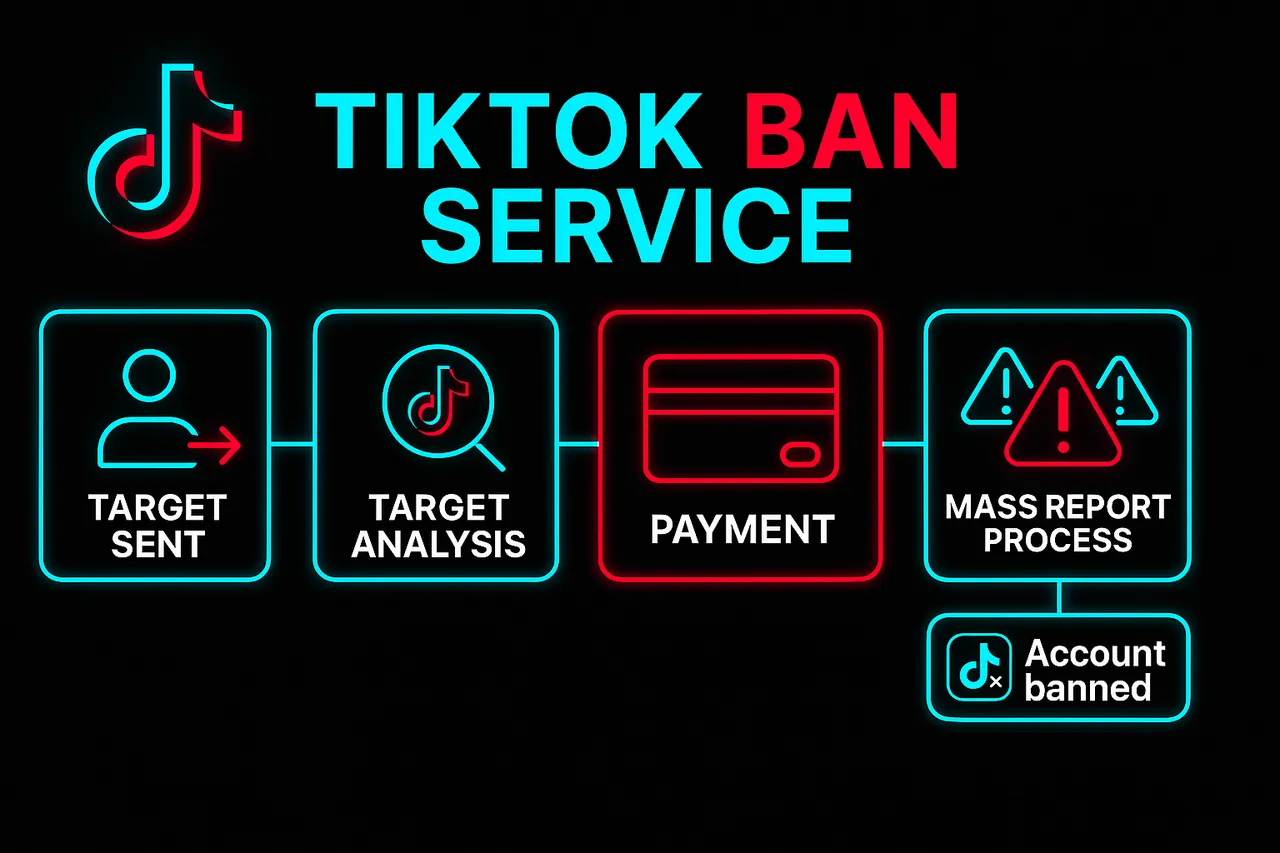
A TikTok ban service is not a button you press and not a brigade. It's an evidence package, filed through the right TikTok form, that documents how an abusive account is breaking the rules — so a moderator can act. Done correctly, it works on impersonators, scammers, IP thieves, and harassment accounts. Done as a bot pile-on, it usually backfires.
What is a TikTok ban service, and what does it actually do?
A TikTok ban service is a managed reporting practice that documents how a target account is breaking TikTok's Community Guidelines or the law, builds a clear evidence package, and files it through TikTok's official in-app, web, and dedicated takedown forms until the account is restricted or permanently banned. It does not run mass-report bots, and it never touches the abuser's login.
Before going further, it helps to disambiguate. The phrase "TikTok ban" pulls double duty in search. One meaning is the country-level dispute — the US Protecting Americans from Foreign Adversary Controlled Applications Act drama through 2025–2026, the executive-order extensions, and the ByteDance divestment talks. That's a political and corporate story, and no service can influence it. The other meaning, and the one this guide covers, is the per-account ban: getting an impersonator, scammer, stolen-content clone, or harassment account removed from your view of the platform. The second meaning is where a TikTok ban service actually does work.
In practice, a legitimate practice is closer to a specialist intake than a piece of software. You describe what the abusive account is doing to you. A specialist checks whether the conduct maps to a TikTok rule a moderator will action. A case file is built — links, handles, timestamps, screenshots, ID where required. Reports go through the correct channel for the violation type. Then the case is tracked: re-filed with additional evidence, escalated where warranted, or stopped honestly when the case isn't there. That is the entire offer — preparation, accuracy, and persistence in the channels TikTok already provides.
Is a "TikTok ban service" different from a TikTok mass report bot?
Yes — and the difference is the whole point. A TikTok ban service built around official channels relies on report validity and severity to win a takedown; a mass report bot relies on volume. TikTok's moderation is designed to ignore the second pattern and act on the first. Pile-on volume without a genuine policy violation is a fast way to get the reporting account flagged for inauthentic behaviour, not to get the target removed.
TikTok itself is candid about this. The platform's Community Guidelines Enforcement Reports show that moderation evaluates each report's accuracy and severity, not the pile-on count. In Q2 2025 alone TikTok removed roughly 189 million videos worldwide and around 77 million fake accounts — overwhelmingly through proactive AI detection (about 99% proactive), not through coordinated user reports. Solo, well-evidenced human reports are still useful where they're correct, but a hundred "spam" reports against a creator someone simply disagrees with will rarely move a single piece of content.
This is why open-source TikTok mass-report bots have such a poor track record in 2026: they spam the same category against the same account from rotated proxies, get pattern-matched as inauthentic activity, and frequently degrade the reporter's own account standing. We cover the bot route in more detail in our TikTok mass report bot walk-through — the short version is that automation without genuine violations is not a strategy. The same logic applies cross-platform: see our mass-report Instagram piece and the equivalent Twitter mass-report bot note.
When does TikTok actually ban an account?
TikTok bans an account when the violation is clear, evidenced, and falls inside a category its policies define — most reliably impersonation, sexual or non-consensual intimate content, hateful conduct targeting protected groups, dangerous activities, fraud and scams, intellectual-property infringement, child safety violations, and repeated lesser breaches that accumulate strikes within a 90-day window. A single severe violation can trigger an immediate permanent ban; lighter violations need a documented pattern.
TikTok's Community Guidelines (the current version effective from September 13, 2025) and the Accounts and Features rules describe how repeated or severe violations lead to account bans. In cases we've handled, the categories that move fastest are impersonation backed by government ID, non-consensual intimate imagery, and verifiable IP infringement. They all have dedicated forms with structured evidence requirements — and that's the format TikTok's moderators prefer.
The most useful way to think about this is a small triage table. Each violation has a "right route" inside TikTok, and the wrong route is usually why a self-filed report stalls.
| Violation | Right TikTok route | What it needs | Typical outcome |
|---|---|---|---|
| Impersonation of you | Dedicated impersonation form (US or non-US) | Government ID + signed statement | Account removal in 1–2 weeks |
| Scam or phishing account | In-app Report account → Fraud and scams | Screenshots, links, evidence of loss | Restriction or ban; refer to FTC/IC3 in US |
| Stolen videos / cloned content | Copyright Infringement Report | Proof of ownership of the originals | Content removal; account ban on repeat |
| Counterfeit TikTok Shop listing | IP Protection Centre (IPPC) | Trademark registration certificate | Listing removal; repeat → seller ban |
| Harassment or threats to you | In-app Report → Harassment & bullying | Documented pattern; saved DMs/lives | Strikes; ban on repeat or severe cases |
| Non-consensual intimate images | Sensitive-content webform + StopNCII | Confirmation it's you, age proof | Priority removal; hash-blocked re-uploads |
| A lawful account you dislike | None — we won't file | — | Abuse of the reporting system |
How a legitimate TikTok account ban service files a case (the four routes)
A professional TikTok account ban service uses four reporting routes in parallel, picking the one that matches the violation and stacking corroborating evidence where multiple categories apply. The four routes are: the in-app or web profile report, the dedicated impersonation web form, the Intellectual Property report (copyright or trademark), and the law-enforcement or DSA notice for illegal content. Most cases live in route one or two; the heavier routes are reserved for IP holders, brands, and serious illegal-conduct cases.
1. The in-app and web-browser report
From the TikTok app, opening the abusive profile and tapping the Share button reveals the Report menu — choose Report account, then the most specific category. TikTok's own documentation walks through the menu paths. The web flow is identical, with the entry point at the three-dot "More options" menu on the profile page. Creators consistently tell us that the desktop browser report goes further than the app on stubborn cases — a small, free habit worth adopting.
2. The dedicated impersonation web form
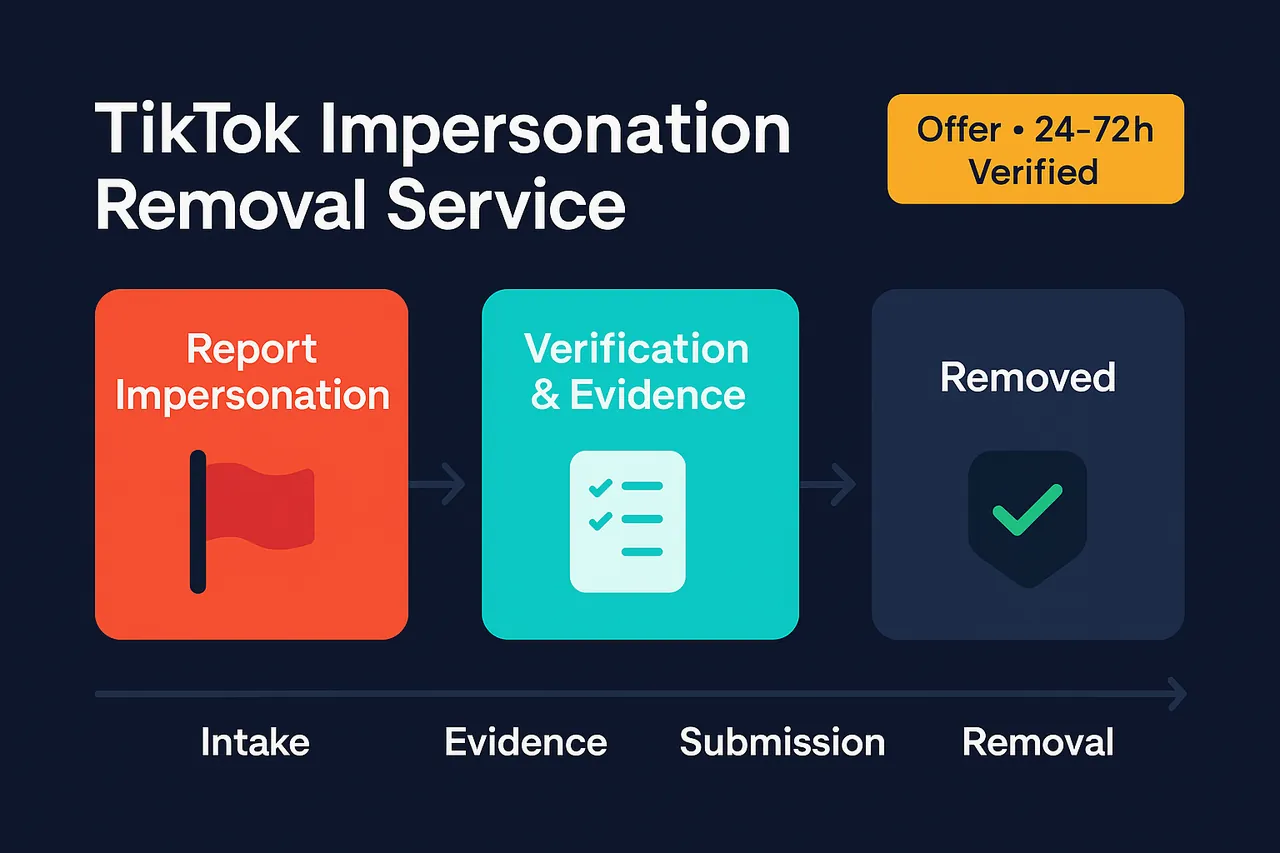
For impersonation specifically, TikTok runs two separate forms: one for accounts based in the US and one for accounts outside the US. The US form asks for ID and a signed electronic statement; the non-US form is reached through the broader "Report a potential violation" portal under Account violation → Impersonation. Both require valid government ID. Submitting the right form for the right region matters; mis-routed forms quietly stall, and that single mistake is the most common cause of "I reported them and nothing happened" stories in our intake.
3. The IP route — copyright and trademark
For cloned content, stolen videos, or accounts trading on a registered trademark, the right route is TikTok's IP Removal Request system. There are separate forms for copyright and for trademark infringement. For TikTok Shop listings the IP Protection Centre (IPPC) lets rights holders register and file against new listings as they appear — the only sensible model when counterfeit sellers re-list daily. We cover this end-to-end on the copyright takedown service page, and brand-level monitoring on the brand protection page.
4. The legal / illegal-content route
If the conduct is illegal — fraud, threats, doxxing, non-consensual intimate images, child sexual exploitation — there is a separate notice channel for illegal content, including the EU's DSA notice-and-action form for European users. For US victims, the FTC and IC3 sit alongside the platform report. This route exists because TikTok recognises that some abuse is a crime first and a Community Guidelines breach second; the notice itself helps both.
Evidence: exactly what to send before we file
The single biggest reason TikTok bans get rejected is thin evidence. A clean case file at first submission saves weeks. Before we file we ask you to gather a specific package — and to be clear up front, we never ask for your password, two-factor codes, or login access. The reporter does not need to be inside the abuser's account.
The minimum evidence pack we'll work from:
- Profile data. The exact profile URL (https://www.tiktok.com/@…), the @handle, the display name, and the account's join date if visible.
- Visual proof. Screenshots that include the visible URL bar and the timestamp. Capture the profile photo, the bio, and any branded imagery being misused.
- Behavioural pattern. Three to five examples of the conduct — comments, videos, lives, DM screenshots. Save full-quality video where possible; lives disappear.
- Your proof of identity (impersonation only). A government-issued ID for the impersonation form. We use it for the submission and do not keep it.
- Rights documentation (IP only). A trademark registration certificate, copyright proof, or DMCA-style declaration.
- Financial loss (scam/fraud only). Transaction screenshots, wallet IDs, and chat logs.
- Any prior report history. If you've already tried reporting, the reference numbers and any rejection emails. These tell us which category was previously used — which is almost always why it failed.
If you don't have all of it, send what you have. Half the value of a ban service is knowing what to add — and what to drop — before the filing.
Stuck in a rejection loop? A re-filed report needs new evidence or the right category — not louder volume. Send us the rejection email and we'll tell you which lever to pull next.
How long does a TikTok ban take, and what can go wrong?
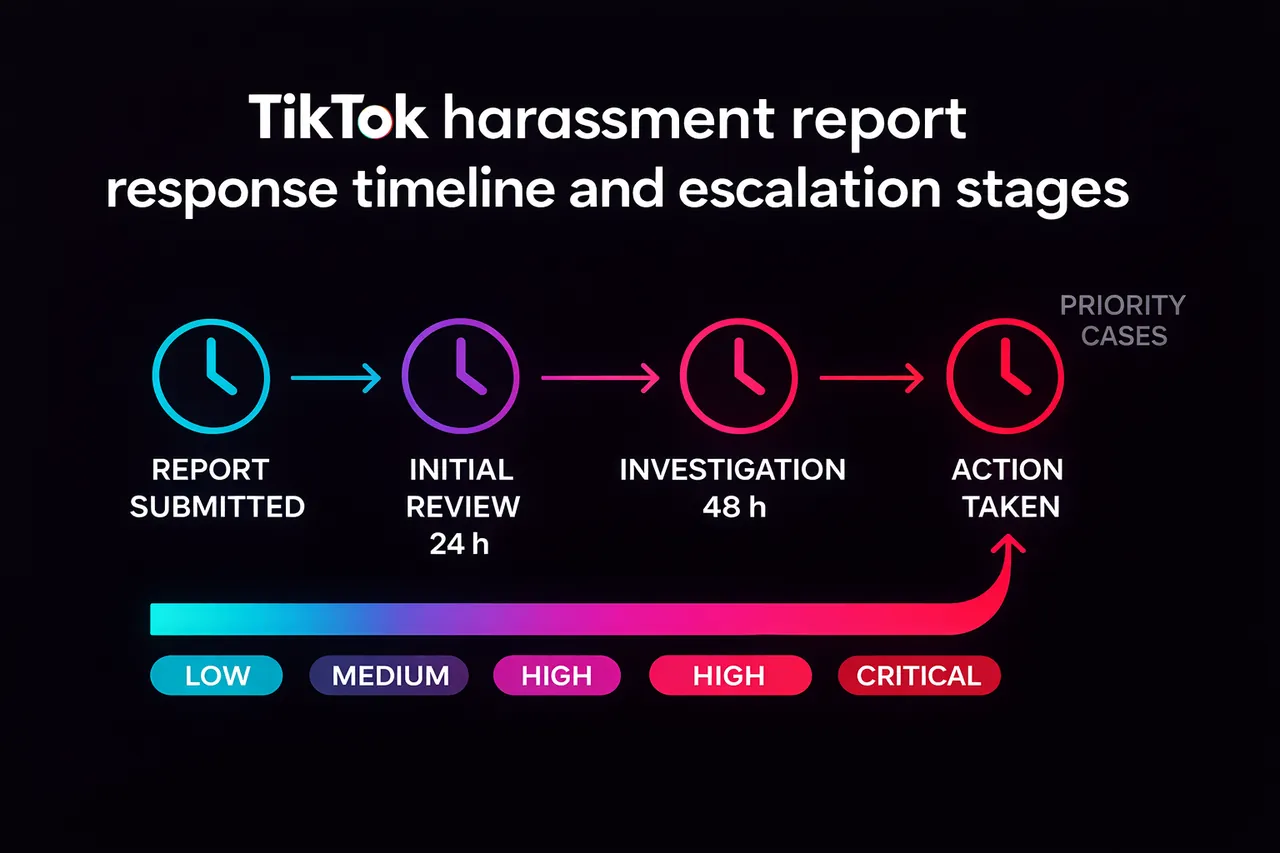
TikTok generally reviews reported content within 24 to 48 hours and structured impersonation form submissions within roughly one to two weeks. Permanent bans on a single severe violation can be near-instant; cases that need an accumulated pattern of strikes are slower because each new strike is only decisive once the previous ones have landed inside the 90-day strike window.
The common failure modes we see in 2026, in order of frequency, are: wrong category chosen (the report has nowhere to land); only one piece of evidence (no documented pattern); the wrong regional form used (US vs non-US); lawful conduct mischaracterised as a violation (TikTok will ignore this on review); and the reporter's own account already rate-limited because of earlier bot-style reports. The fix in all five is the same — file once, file correctly, with evidence.

EU and US legal routes when TikTok's own moderation isn't enough
When TikTok's internal moderation either rejects a case or moves too slowly, there are statutory routes — and a TikTok ban service that understands both regions can keep the case moving. In the EU, the Digital Services Act gives every user a right to a usable notice-and-action mechanism for illegal content under Article 16, and a complaint route through national Digital Services Coordinators. In the US, the FTC's reportfraud.ftc.gov and the FBI's IC3.gov handle financial fraud and cybercrime, while the DMCA process compels removal of infringing material with a properly formed notice.
The European Commission has been actively investigating TikTok under the DSA through 2025–2026, which has, in practice, sharpened removal timelines for verifiable illegal content in the EU. GDPR's right to erasure can apply when personal data — including personal images — is being processed unlawfully. For image abuse cross-border, the global tools StopNCII.org and NCMEC's Take It Down pre-emptively hash and block re-uploads on TikTok and other participating platforms. Whichever route applies, the rule is the same: layer the platform report with the statutory notice; don't substitute one for the other. The same playbook is used in our cross-platform pieces on mass-reporting an X account and the Instagram spam-report bot question.
What an ethical TikTok ban service will never do
An ethical TikTok ban service has clear hard lines — and it's the single biggest difference between a legitimate practice and a brigade tool. We won't take work that crosses any of them, even when offered, because doing so would be dishonest with the client, harm someone undeserving, and breach TikTok's policies in ways that endanger every future legitimate filing the team makes.
The hard lines:
- No work against lawful accounts. A creator you simply dislike is not a case. A competitor whose content is legal is not a case. Differences of opinion are not policy violations.
- No mass-report brigades. Coordinated inauthentic reporting is detectable, and harms the reporter more reliably than the target.
- No fabricated evidence. No invented screenshots, no doctored timestamps, no fake DMs.
- No false impersonation claims. Misusing the impersonation form against a real second user is a serious abuse of the system and can boomerang into a ban for the filer.
- No password requests. Ever. Anyone, including anyone claiming to represent us, asking for your TikTok password or 2FA codes is a scam.
- No guaranteed outcomes. Every ban depends on TikTok's own independent review. Anyone "guaranteeing" a ban is selling you something else.
If your case fits, message us on Telegram or WhatsApp with the profile link and what's been done to you. We'll tell you honestly whether it's actionable — and what the next 48 hours should look like. If your case doesn't fit, we'll tell you that too. That's the whole offer. More on how we work on the about page, and if you suspect your own TikTok has been hit by a retaliatory wave, the account recovery service covers that route.
Frequently asked questions
Can a TikTok ban service guarantee a permanent ban?
No legitimate TikTok ban service can. Every ban depends on TikTok's own independent review of the evidence against its Community Guidelines. What a credible service does is dramatically improve how the case is built, categorised, and submitted — and re-file with new evidence if the first attempt is rejected. Guarantees in this field are a scam signal.
How many reports does it take to ban a TikTok account?
There is no fixed number. TikTok evaluates reports on validity and the severity of the violation, not volume. A single well-evidenced report against a clear policy breach can trigger an immediate permanent ban. A hundred low-quality reports against a lawful account will be filtered as inauthentic activity and may degrade the reporting accounts.
Is a TikTok account ban service legal?
A TikTok account ban service is legal when it acts for legitimate victims and files honest, evidence-based reports through TikTok's official channels — the same routes any user can use themselves, just better prepared. It becomes illegitimate, and a TikTok terms-of-service breach, the moment it brigades lawful accounts, fabricates evidence, or files false impersonation claims.
Will a TikTok ban service ask for my password?
Never — and if any service asks, walk away. TikTok's official reporting flows do not require the reporter to log into the abusive account. Impersonation and IP forms ask for your own identification, not your TikTok credentials. Anyone, including anyone claiming to represent us, asking for your password or two-factor codes is running a scam.
How long does TikTok take to ban an impersonation account?
In our experience, in-app impersonation reports against clear-cut fake accounts can be actioned within 24 to 48 hours. The dedicated impersonation web form — which requires ID upload — typically resolves in roughly one to two weeks, although TikTok notes processing can take longer for complex or appeal cases. Persistent re-filing with fresh evidence shortens the timeline.
Can I report a TikTok account from outside the US?
Yes. TikTok runs a separate non-US impersonation form, reached through the broader Report a potential violation portal under Account violation then Impersonation. In the EU, the Digital Services Act Article 16 notice-and-action mechanism gives every user a legal right to flag illegal content. For brand or rights-holder cases the IP forms work globally regardless of the reporter's country.
What's the difference between a TikTok ban service and a mass report bot?
A TikTok ban service relies on evidence, correct categorisation, and the official channels TikTok's moderators actually action — so genuine violations get acted on. A mass report bot relies on volume from automated accounts, which TikTok pattern-matches as inauthentic activity. The first occasionally works on a real violation. The second usually backfires onto the reporter's own standing.