Impersonation removal for fake profiles and pages
Impersonation removal is the process of getting a platform to take down a profile or page that falsely presents itself as you or your brand. Every major platform prohibits impersonation, and the report succeeds on clear proof: your identity, the impostor's profile, and a side-by-side that shows the deception. We prepare that report and escalate it for you, taking the case from first evidence to removal.
Someone pretending to be you?
Send us the fake profile or page link — we'll build the case and push to get the impersonator removed.
We never ask for passwords · Legitimate owners & genuine victims only · No guaranteed outcomes
What counts as impersonation — and what doesn't
Impersonation is when an account pretends to be you, your business, or your brand in a way designed to mislead — copying your name, photos, and bio to trick your audience, scam your followers, or damage your reputation. Platforms treat this as a clear policy violation and provide dedicated reporting routes for it, often with a faster track for verified identity or trademark holders.
Parody, commentary, fan accounts that clearly label themselves, and people who simply share your name are generally not removable, and we won't pretend otherwise. The line is deception: an account has to be passing itself off as the real you. When it crosses that line, a well-evidenced report is the fastest legitimate way to get it down.
How we get a fake profile removed
We build the report the platform actually needs: your proof of identity or brand ownership, the exact URL of the impersonating account, and clear evidence of the deception — matching names, copied images, and any messages where the impostor claims to be you. We file through the official impersonation channel, use the trademark or verified-identity route when it applies, and escalate if the first pass is auto-rejected.
For brands and public figures facing repeated impostors, we can pair one-off removals with ongoing monitoring so new fakes are caught and reported quickly.
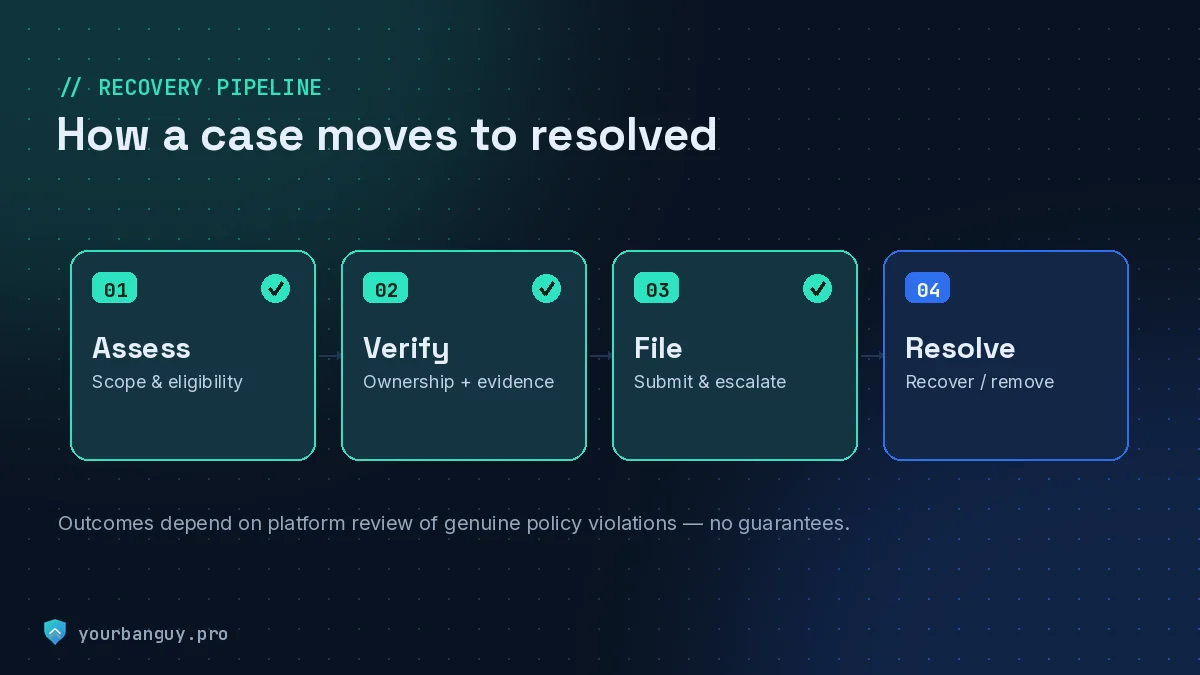
Why evidence and the right channel matter
Impersonation reports are decided on documentation, not volume. A single precise, well-evidenced report through the correct channel is far more effective than dozens of vague ones — and mass-reporting is itself against platform rules. We never brigade or file false reports. We assemble one strong, truthful case and push it to the right reviewer.
Where we draw the line
This is a category crowded with scams and harassment-for-hire. Our boundaries are the point — they're what make a removal stick and what makes us safe to work with.
What we will do
- Report accounts that deceptively impersonate you
- Use trademark and verified-identity fast tracks
- Pair removals with monitoring for repeat impostors
What we won't do
- Report parody, commentary, or clearly labelled accounts
- Mass-report or file false impersonation claims
- Target someone who merely shares your name
Frequently asked questions
How do I prove someone is impersonating me?
The strongest evidence is a clear link between the real you and the deception: government or business ID, the official account or website, and the impersonating profile's URL alongside screenshots showing copied names, photos, and any claims to be you. Messages where the impostor poses as you to others are especially persuasive. We help you compile this into one report.
Can you remove an account impersonating my business or brand?
Yes. Brand and trademark impersonation is treated seriously, and many platforms offer a dedicated route for rights holders that moves faster than the standard flow. We file with your trademark or business documentation and escalate through the brand channel. For ongoing protection, we can monitor for new fakes and report them as they appear.
What if the platform rejects my impersonation report?
A first-pass automated rejection is common and not the end. We review why it likely failed — usually missing proof or the wrong report category — strengthen the evidence, and escalate through the correct channel, including trademark or verified-identity routes where eligible. Persistence with better documentation is what turns a rejection into a removal.