Scam and fraud reporting that gets results
Scam and fraud reporting is the process of getting platforms to remove phishing pages, fake shops, and investment scams. Reports succeed when they clearly document the fraud: the scam's URL, how it deceives people, and the harm to victims. Send us what you've found and we take it from here — packaging the evidence and filing it through each platform's dedicated fraud channel.
A scam trading on your name?
Show us the phishing page, fake shop, or scam account — we'll report it through the right channels to get it taken down.
We never ask for passwords · Legitimate owners & genuine victims only · No guaranteed outcomes
The scams platforms will act on
Platforms remove content whose purpose is to defraud — and a precise report speeds that up. The common cases we handle include phishing pages that harvest logins or payment details, fake shops that take money and never ship, cloned brand pages running giveaway or refund scams, and investment or crypto schemes promising guaranteed returns. The unifying factor is deception for financial gain, which every major platform prohibits.
A strong report shows three things clearly: where the scam lives, exactly how it tricks people, and that real users are being harmed. We assemble that picture so a reviewer can act quickly.
How we report a scam effectively
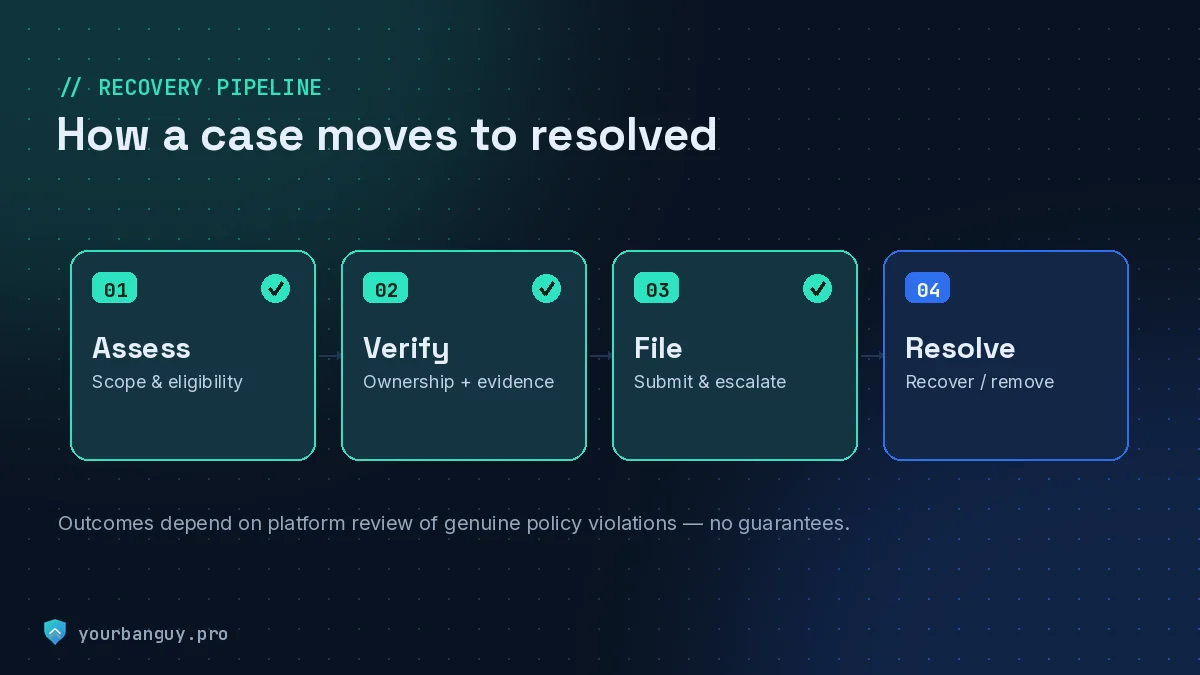
We capture the evidence properly — full URLs, screenshots with visible addresses and timestamps, the payment or contact details the scam uses, and any victim reports — then file through the platform's official scam or fraud channel rather than a generic complaint. Where the scam impersonates a real brand, we add the trademark angle to strengthen and speed the case.
We report only genuine fraud, with evidence. We never file false reports against legitimate sellers or competitors, and we never use reporting to settle disputes.
Why a documented report beats volume
One well-documented fraud report through the right channel outperforms a flood of vague flags — and coordinated mass-reporting violates platform rules. We don't brigade. We build a single, evidence-backed case that shows the deception and the harm, and we escalate it correctly if the first review stalls.
Where we draw the line
This is a category crowded with scams and harassment-for-hire. Our boundaries are the point — they're what make a removal stick and what makes us safe to work with.
What we will do
- Report genuine phishing, fake shops, and scams
- File through official fraud and brand channels
- Document the deception and the harm to victims
What we won't do
- Report legitimate sellers or competitors
- Use reporting to win personal disputes
- Mass-report or file fabricated fraud claims
Frequently asked questions
What information do you need to report a scam?
The essentials are the scam's exact URL, screenshots with visible addresses and timestamps, a clear explanation of how it deceives people, and the payment or contact details it uses. Victim messages or reports strengthen the case. If the scam impersonates a brand, that brand's details help us add a trademark angle. We'll guide you on capturing each item correctly.
Can you report scams that are using my brand or name?
Yes — and those are among the strongest cases. A scam impersonating your brand violates both fraud and impersonation policies, so we file on both grounds and use the rights-holder route where available. This combination tends to move faster than a fraud report alone. We can also monitor for repeat scam pages targeting your brand.
Do scam reports actually get pages removed?
Well-documented fraud reports filed through the correct channel are actioned regularly, because platforms have strong incentives to remove financial scams. No one can guarantee a removal — the decision is the platform's — but evidence quality and the right channel are what move a case. We focus on both, and escalate when needed.