Telegram account takedown (2026): channels, groups, bots
A Telegram account takedown is a structured, evidence-led request that asks Telegram to remove a channel, group, bot, or account that violates its Terms of Service or copyright law. As of 2026, well-formatted reports route through five distinct endpoints — and resolve in days, not weeks.
Need a Telegram channel, group, or account taken down?
Send us the t.me/… link with what's happening — we'll route the report to the right Telegram endpoint and follow up until it's actioned.
We never ask for passwords · Legitimate owners & genuine victims only · No guaranteed outcomes
A Telegram account takedown means filing a structured, evidence-backed report through the right Telegram endpoint — the in-app Report button, @notoscam, [email protected], [email protected], or @TIDABot — depending on whether the violation is scam, impersonation, copyright, or non-consensual imagery. Well-documented cases now resolve in days, not weeks, after Telegram's August 2024 cooperation shift.
- What is a Telegram account takedown?
- Why takedowns hit harder in 2026
- Which endpoint for which violation
- Telegram channel takedown
- Telegram group takedown
- Telegram DMCA takedown
- The evidence pack Telegram acts on
- DIY vs professional — what's different
- How a takedown service works
- Telegram vs other platforms
- What Telegram won't take down
What is a Telegram account takedown?
A Telegram account takedown is the platform's process for restricting or removing a channel, group, bot, or account that breaks its Terms of Service, the law of a jurisdiction Telegram serves, or copyright held by a third party. It is not a button you can press against accounts you simply dislike — Telegram's moderation team only acts on documented violations of the rules.
Reports route through five official endpoints, and routing matters as much as the evidence. The in-app Report button handles most categories. @notoscam handles scams and impersonation. [email protected] handles copyright. [email protected] handles other illegal content. @TIDABot handles non-consensual intimate images under the US TAKE IT DOWN Act. We will explain which goes where in the next section.
In our case work, reports that route correctly the first time get actioned three to five days faster than the same case sent to the generic abuse address. The endpoint matters as much as the evidence pack itself.
Why Telegram takedowns hit harder in 2026 than they used to
Telegram takedowns work materially better in 2026 than they did before August 2024. After CEO Pavel Durov's arrest in France and the platform's September 2024 policy shift, Telegram began responding to a much broader range of abuse and law-enforcement requests, and public-channel moderation visibly tightened across 2025 and 2026.
The numbers tell the story. Telegram fulfilled roughly 14 US data requests in the first nine months of 2024 — and 900 in the same year after September. The same shift bled into abuse reports: cases that would have been ignored in 2023 now route through automated triage, human review, and visible action against public channels.
The practical effect for a Telegram account takedown in 2026 is direct: a well-formatted, correctly-routed report against a public channel, bot, or group that clearly violates the rules now has a realistic shot. The same report, sent unstructured to the generic abuse inbox, often goes nowhere.
Telegram now publishes a regularly updated FAQ on reporting with precise endpoints and in-app menu paths, plus a separate EU Digital Services Act page for users covered by the DSA. The platform's legal entity is based in Dubai, which determines which jurisdiction's DMCA-equivalent procedures apply — relevant when escalating contested cases.
Which Telegram endpoint for which violation
The single biggest mistake in DIY Telegram takedowns is sending every report to [email protected]. Telegram routes by violation category, and a misrouted report can lose five to seven days before it surfaces in front of the right team. Use this table when you decide where to file.
| Violation type | Right endpoint | What to include |
|---|---|---|
| Scam, impersonation, phishing bot, fake giveaway | @notoscam bot + in-app Report | Forwarded scam message, profile link, screenshots, dated incidents |
| Copyright (channels, groups, bots, posts, sticker sets) | [email protected] | Proof of ownership, original work URL, every infringing t.me/… link, signed good-faith statement |
| Non-consensual intimate images (under US TAKE IT DOWN Act) | @TIDABot | Reporter identity proof; do not send the images themselves |
| Child safety (CSAM, grooming, sextortion of minors) | [email protected] | Brief description, URL, country — Telegram fast-tracks within 24h via the NCMEC partnership |
| Drugs, weapons, terrorism, other illegal content | [email protected] | URL, jurisdiction, brief description; cite the specific law where possible |
| Terrorist content under EU Regulation 2021/784 | EU DSR via @EURegulation bot | URL, EU country, content type — handled by Telegram's European Digital Services Representative |
| Harassment, doxxing, targeted abuse | In-app Report + [email protected] | Pattern across multiple days, dated screenshots, message links |
| EU residents — any of the above under the DSA | EU DSA complaint route | Same evidence plus your country of residence |
The in-app Report button's path depends on platform. On Android, tap the message and select Report from the menu. On iOS, press and hold the message. On Telegram Desktop, Web, or Telegram for macOS, right-click the message and select Report, then choose the appropriate reason. Telegram's official FAQ confirms these exact paths.
The reason a Telegram takedown service tends to outperform DIY isn't access to special channels — it's that we pick the right row of this table every time and format the report the way that team expects.
Telegram channel takedown: removing a public broadcast
A Telegram channel takedown is reviewed differently from an account takedown because channels are public broadcasts that anyone can find — the same surface Telegram polices most aggressively. For a channel takedown to stick, your report needs the channel handle, several dated message links, and a clear mapping to the specific rule or law being broken.
Channels are also where scam, copyright, and impersonation cases converge. A typical pirate course channel charges roughly $3–10 per month for access to thousands of stolen works, rotates invite links to avoid disruption, and runs payment-bot access control. The same channel often hosts impersonation of the original creator's brand alongside the leaked files — meaning a complete report can hit copyright and impersonation in one package.
For a Telegram channel takedown we file the copyright complaint to [email protected], the impersonation complaint to @notoscam, and the scam-payment complaint to [email protected], then follow up after 72 hours with any additional evidence Telegram's team asks for. Cross-platform sibling work — see our TikTok ban-service playbook — uses the same evidence discipline, just routed through a different abuse team.
When Telegram removes a channel, the URL returns "Sorry, this channel doesn't seem to exist" and the @handle is held back from re-registration for a cooling period. Subscribers see the channel disappear from their list. The handle freeze is the strongest signal a real channel takedown happened, not a one-off content delete.
Telegram group takedown: public vs private group rules
A Telegram group takedown splits cleanly into two cases. Public groups follow the same evidence rules as channels — direct message links, dated screenshots, and policy mapping go to the in-app Report button, @notoscam, or [email protected] depending on what the group is doing. Private groups require additional evidence: invite-link history, member context, and a credible account of how you encountered the content lawfully.
The private-group distinction matters because Telegram's FAQ on takedowns draws a clear line: the platform does not moderate Secret Chats or one-to-one private conversations after the fact. What it does action is reported public links, posts, and bots — plus private groups where the evidence package is strong enough to overcome the access barrier.
For scam-broadcast groups posing as official brand communities, we package the report alongside a brand-protection note — particularly when the same operator runs a network of clone groups. The scam and fraud reporting route handles the bulk of these; the impersonation removal work runs in parallel for the brand misuse.
The same group keeps coming back? Group takedowns often have to be re-filed when the operator rebuilds under a new invite link. We track and re-file every rebuild — message us with what you're seeing and we'll set up the ongoing watch.
Telegram DMCA takedown: copyright the right way
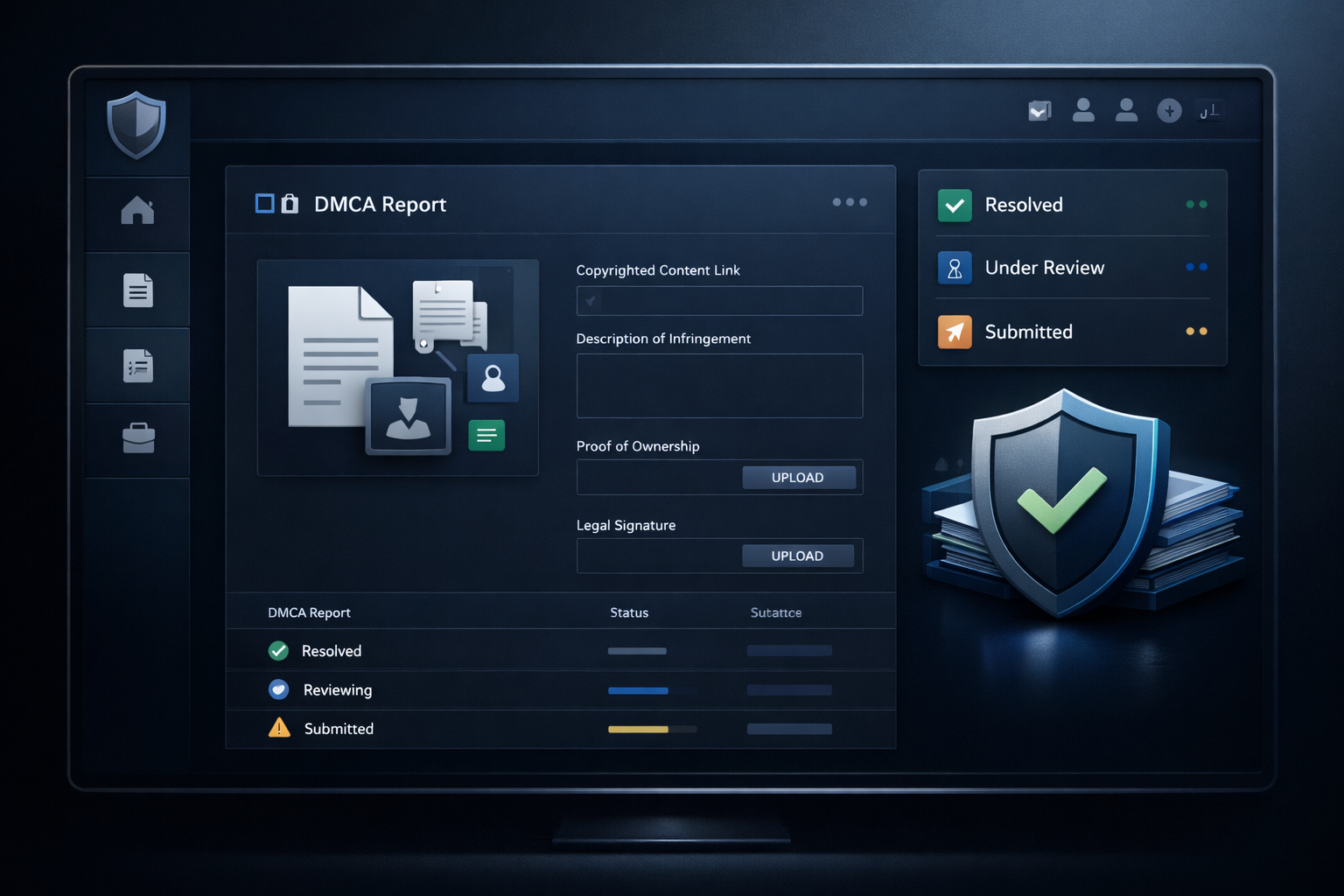
A Telegram DMCA takedown is the route for copyright-infringing content — leaked courses, pirated film and OTT material, stolen photosets, software, ebooks, and trademark abuse — filed by email to [email protected]. The notice must follow the requirements of 17 U.S.C. § 512(c)(3): identification of the work, exact infringing URLs, contact details, and a signed good-faith statement under penalty of perjury.
Telegram is a Dubai-headquartered company that honours DMCA-style copyright notices for content on its public platform. The platform's official FAQ explicitly lists [email protected] as the route for sticker sets, bots, channels, and groups that infringe copyright. Response times average 5–14 days for clean notices and longer for contested or counter-noticed cases.
The notice itself is short. Here is the exact structure we use:
- Subject line: DMCA Takedown Notice — Unauthorised distribution of [Work title]
- Identification of the copyrighted work, with a link to the original source you control
- A bullet list of every infringing t.me/… URL — Telegram requires the direct message link, not just the channel
- The good-faith and accuracy declarations under penalty of perjury
- Your full legal name, contact email, postal address, and signature
What if the Telegram channel files a counter-notice?
A counter-notice triggers the 10–14 day clock under DMCA section 512(g) before Telegram is obliged to restore the content — unless the rights holder files a lawsuit. Counter-notices on Telegram are rare in our experience but consequential when they arrive: they shift the dispute to litigation territory and the rights holder must decide whether to escalate.
We treat counter-notices as a sign that the operator is commercial and organised. The response includes additional ownership evidence, identification of the operator's payment processor (Stripe, PayPal, crypto), and where appropriate, parallel reporting to those processors. The goal is to make rebuilding cost the operator more than it earns.
Non-consensual intimate images are not filed through the DMCA route — that work goes through @TIDABot under the US TAKE IT DOWN Act, alongside StopNCII.org and NCMEC's Take It Down. Our intimate-image removal work covers that distinct workflow end-to-end; never send the images themselves to anyone running a takedown — legitimate services never ask for the imagery, only proof of identity.
The evidence pack that gets your Telegram report actioned
The evidence behind a real Telegram account takedown isn't long screenshots — it's the smallest structured pack that maps each artifact to a specific policy clause. Volume of evidence past a certain point reduces signal: triage queues skip walls of text.
Here is the exact pack we ask for, in the order it appears in the filed report:
- Channel/group/bot/account handle and t.me/ URL — the @handle and the full https://t.me/… link.
- Direct message links to the specific infringing posts — one link per offending post. Telegram's abuse team prioritises reports that point at posts, not just at the entity.
- Dated screenshots — taken with the device clock visible. Avoid edits; raw screenshots are stronger than annotated ones.
- Policy clause being broken — name the specific Terms of Service section, Community Guideline, or law. "It's a scam" is weaker than "Investment fraud under Telegram ToS section on misleading content + UK Fraud Act 2006 section 2".
- Proof of ownership or identity — for copyright, a link to the canonical original; for impersonation, a government-issued ID with the name matching the impersonated account.
- Reporter contact details — email and country of residence (the last triggers correct EU DSA routing where applicable).
For brand owners and creators dealing with repeat infringement, we maintain the pack as a living document and refresh it every time the target redeploys — same pack, new URLs. That continuity is the difference between a one-off win and a sustained takedown programme. The brand-protection workflow runs the ongoing monitoring; the copyright takedown service runs the filing.
DIY vs professional Telegram takedown — what's actually different
Most users start a Telegram account takedown with the in-app Report button and a generic email to [email protected]. That works for clear-cut cases. When it does not work, the gap between DIY and a professional Telegram takedown service is operational, not magical — no one has a back-door to Telegram. Here is the honest side-by-side.
| What gets done | DIY (in-app + generic email) | Professional service |
|---|---|---|
| Endpoint routing | Usually one inbox for everything | Mapped to the table above per violation |
| Evidence packaging | Variable — often too long or too thin | Standardised 6-item pack matching Telegram's triage |
| Policy-clause citation | "It's harmful" | Exact ToS section + applicable law (DMCA, DSA, UK Fraud Act) |
| Re-filing on rebuild | Manual, slow | Monitored — every new handle triggers a fresh report |
| Counter-notice response | Often unaware it happened | 10–14 day clock tracked; processor and Google delisting in parallel |
| Cross-platform follow-through | Stops at Telegram | Google + Bing + downstream-mirror delisting once Telegram link removed |
| Typical resolution time | 2–6 weeks if it works; often it doesn't | 24–72 hours for clean public-entity cases; 5–14 days for DMCA |
The case for DIY: it costs nothing and works for single, obvious violations. The case for professional help: when the target rebuilds, when the violation type is mixed, when the operator counter-notices, when the Telegram link has already been Google-indexed, or when the volume is too high for manual reporting to keep up.
How a professional Telegram takedown service works — and what to avoid
A legitimate Telegram takedown service packages your evidence, picks the right endpoint per violation, files in the format Telegram's team actually responds to, and re-files when the target rebuilds. What to avoid: anyone selling "guaranteed bans", anyone running mass-report bots aimed at lawful accounts, and anyone asking for your password.
The honest version of this work runs through five distinct stages:
- Discovery — finding every clone, mirror, and bot redeploying the target content; mapping the operator's surface.
- Documentation — building the 6-item evidence pack above and mapping each artifact to a specific policy clause.
- Routing — selecting the right Telegram endpoint per violation type from the table above.
- Filing — sending the report in the exact structure Telegram's abuse and DMCA teams expect, including the platform-specific in-app Report path where it adds weight.
- Follow-up — re-filing at the 72-hour mark with any additional evidence, tracking re-deployments, handling counter-notices, and running cross-platform delisting (Google, Bing, downstream forums) once the Telegram link is removed.
What we will not do, and what no honest Telegram takedown service should do: mass-report lawful accounts you simply disagree with, target competitors who aren't breaking the rules, run coordinated false-flag reports (Telegram's moderators detect coordinated false reporting and discount it — and it can hurt the reporter's own standing), or guarantee any specific outcome. Telegram makes the final call; we make the case for them to make it. The same standard applies on every platform — see our X / Twitter mass-report account guide and the Instagram account takedown playbook for the parallel work elsewhere.
We also never ask for your password. Telegram's recovery, restriction, and reporting flows are built around identity verification, not credentials. Anyone — including anyone claiming to represent us — who asks for your Telegram password is acting fraudulently. The team page describes how we operate without ever holding your access.
Already filed yourself and got nothing back? Send us the rejection or the silence — we re-package and re-route. Tell us what you sent and what happened and we'll start the re-file the same day.
Telegram vs other platforms — why this one is different
Telegram takedowns are genuinely harder than Instagram, TikTok, or X takedowns, for three concrete reasons. First, there is no web form — every report goes through bots, in-app menus, or email, none of which gives a public case number. Second, Telegram's primary jurisdiction is Dubai, not California, so US-only DMCA habits do not transfer cleanly. Third, the platform deliberately does not moderate private chats, which limits the surface area where any Telegram account takedown can act.
On Instagram and TikTok, the platforms maintain dedicated takedown web forms with structured fields, case-tracking dashboards, and DMCA agent registrations under US copyright law. A Meta takedown filed at noon often shows status by 18:00. Telegram has no equivalent surface — you wait, and you re-file. Our Instagram account takedown and X mass-report guides cover those workflows in their native detail.
The compensating advantage on Telegram: the August 2024 cooperation shift means well-formatted reports now produce faster real-world removals than they did at any prior point. A 2026 Telegram account takedown is harder than the equivalent on Instagram or TikTok, but the recent shift has narrowed the gap.
What Telegram won't take down
No Telegram account takedown succeeds against lawful speech, private one-to-one chats (Telegram does not moderate them after the fact), Secret Chats, opinions you simply disagree with, or competitor channels that aren't breaking the rules. Reports without verifiable evidence — or that target lawful accounts — get discounted by Telegram's moderation team and can hurt the reporter's standing.
Telegram is also explicit in its official takedown policy that it will not act on "local restrictions on freedom of speech" — for example, criticism of a government that is illegal in some country. That ethics line cuts both ways: Telegram blocks terrorist content and CSAM but does not block lawful dissent.
The cases we decline, and that any responsible operator should decline: harassment campaigns disguised as takedowns, competitor sabotage, attacks on journalists or critics for lawful reporting, and any request to ban an account whose only fault is disagreeing with the requester. That ethics gate sits across every platform we work on.
Frequently asked questions
How long does a Telegram account takedown actually take in 2026?
Well-documented cases usually clear in 24–72 hours through the in-app Report button and @notoscam. Copyright reports to [email protected] typically take 5–14 days. Contested cases, private-group cases, and bot re-deployments take longer because the target often rebuilds under a new handle and the report has to be re-filed.
What is a 'frozen' Telegram account and is it the same as a takedown?
A frozen account is Telegram's middle-ground state — the user can still read chats but cannot send messages or post content. It results from accumulated user reports. A full Telegram account takedown removes the entity entirely and freezes the @handle from re-registration; a freeze is reversible on appeal, a takedown usually is not.
Can you do a Telegram DMCA takedown for content in a private group?
Yes — but a Telegram DMCA takedown for a private group needs more evidence than a public-channel report. Telegram's legal team will want the invite-link history, the dated screenshots of the infringing posts with the group name visible, message links if available, and a credible account of how you encountered the content lawfully. Without that, the report stalls.
What is the real difference between a Telegram channel takedown and a Telegram group takedown?
A Telegram channel takedown targets a public broadcast surface that anyone can find — channels are moderated most aggressively because they reach the widest audience. A Telegram group takedown splits into public groups (similar evidence to channels) and private groups (extra evidence required). Both file through [email protected] or [email protected] depending on the violation type.
What does a Telegram takedown service do that I cannot do myself?
A Telegram takedown service handles every stage of the Telegram account takedown workflow: routing each report to the endpoint Telegram's moderators actually action, formatting the evidence the way the abuse and DMCA teams expect, and re-filing when the target rebuilds. We also handle the Google delisting where the Telegram link surfaced in search, and follow counter-notices through their statutory clock.
What happens if the Telegram channel files a counter-notice against my DMCA?
A counter-notice triggers a 10–14 day clock under DMCA section 512(g) before Telegram restores the content unless the rights holder files a lawsuit. Counter-notices on Telegram are rare but consequential; they shift the burden to litigation. We respond with additional evidence, identify the operator's payment processor, and escalate jurisdictionally where the content moves to Dubai-based or Singapore-based servers.
Will Telegram remove a bot that is reposting my content?
Yes. Bot takedowns route through [email protected] for copyright infringement or @notoscam for scam and impersonation bots. Telegram acts on bots faster than accounts because bots are categorised as third-party developer content under the official FAQ. Include the bot's @handle, sample message links, and what specifically it is distributing.
Will Telegram tell the channel owner or account holder who reported them?
No. Telegram's reporting system keeps the reporter's identity private. The reported party is notified only of the action taken — a warning, restriction, freeze, or removal — not who filed the report. This applies to the in-app Report button, @notoscam, the abuse and DMCA emails, and EU DSA submissions.