Twitter Account Takedown on X: How to File DMCA & Abuse Removals
A Twitter account takedown on X is a formal removal request filed through one of four official routes: DMCA copyright, impersonation, trademark, or an EU Digital Services Act notice — depending on the harm. Each needs direct post URLs, proof of ownership, and a compliant notice. X usually reviews valid DMCA requests within three business days.
Need to take down a copycat or copyright thief on X?
Send us the post URLs and proof you own what's being copied — we'll prepare and file the right Twitter account takedown through X's official channels. No passwords, no shortcuts.
We never ask for passwords · Legitimate owners & genuine victims only · No guaranteed outcomes
Four routes, one principle: DMCA covers stolen images, video, and text; the impersonation form covers fake-you accounts; trademark covers brand misuse; the EU's DSA covers illegal content for European users. Pick by harm — not by what sounds most powerful.
X's copyright policy remains under 17 U.S.C. § 512 (DMCA); the official complaint forms live at help.x.com/en/forms/ipi/dmca (copyright) and help.x.com/en/forms/authenticity/impersonation (impersonation). EU users can also file under the Digital Services Act, under which the European Commission imposed its first non-compliance fine on X — €120 million — in December 2025. We update this guide whenever X changes a form, policy, or response window.
- What "Twitter account takedown" actually means on X today
- Can you request a takedown of a Twitter account?
- The four official takedown routes on X
- How to file a DMCA takedown on Twitter, step by step
- The privacy heads-up: X forwards your full address to the infringer
- The EU route: filing a DSA notice on X
- What happens after you submit a Twitter takedown request
- How to read a Twitter DMCA takedown notice you've received
- "Twitter takedowns" that aren't legal takedowns
- What we will and won't do (and why no one guarantees outcomes)
What "Twitter account takedown" actually means on X today
A Twitter account takedown is the formal removal of content or a whole account from X — formerly Twitter — through one of four official complaint channels: DMCA copyright, impersonation, trademark, or an EU Digital Services Act notice. Each has its own form and is decided by X's internal teams against US law, EU law, or the platform's own rules. A Twitter account takedown is a legal instrument, not a public-opinion vote.
Two pieces of vocabulary trip people up. First, "Twitter" and "X" are the same platform — Elon Musk renamed the company in July 2023, but the legal entity, help-centre URLs (now at help.x.com), and policies all rolled forward. A search for an x account takedown and a search for a Twitter account takedown land on the same form.
Second, "takedown" here means a legal or policy-driven removal — not a sharp public criticism or an organised pressure campaign. X removes accounts that break its rules or US/EU law. It does not remove accounts because users dislike them. We unpack the alternate meanings of "Twitter takedown" further down so you can tell whether you actually need the legal process this guide describes.
Why this guide uses both "Twitter" and "X"
Most search queries still use "Twitter". Google Trends data through early 2026 shows queries for "twitter" running roughly ten times those for "x account" on takedown topics. We use both names because user demand uses both names, and because the platform's own documentation does too: X's copyright policy still references Twitter, the DMCA-designated agent on file with the US Copyright Office still uses the Twitter legal entity, and the EU DSA designation rolled forward from the rebrand. A Twitter account takedown and an X account takedown are the same legal instrument.
If you arrived because someone is reposting your photos, video, art, or paid content on X — or running a profile that pretends to be you — the rest of this guide is the answer. If you arrived hoping to get a politician or a brand you dislike suspended, X is not going to do that for you, and we don't take that work.
Can you request a takedown of a Twitter account?
Yes — when the account is the vehicle of the harm. A Twitter account takedown request succeeds when an account exists primarily to infringe copyrights, impersonate a real person or brand, run scams, or sustainably violate platform policies. X does not remove accounts because their owner is rude, wrong, or politically opposed to you.
Post-level vs full Twitter account takedown
What you usually file first is a post-level request — a twitter takedown request aimed at specific tweets, media, or profile elements (avatar, header, bio) that infringe your rights. Account-level removal happens when those post-level removals stack up. X's copyright policy applies its "repeat infringer" rule when multiple complaints against an account are upheld or other evidence shows a pattern, leading to suspension.
The repeat-infringer rule on X
Industry guides covering 2024–2026 enforcement describe roughly six valid copyright strikes as the practical ceiling before permanent suspension, though X reviews each case individually and does not publish a strict numeric rule. The same end state — full account removal — is also reached through sustained impersonation, coordinated fraud, or large-scale terms-of-service violations. X's policy explicitly notes that retractions and successful counter-notices reduce the strike count, so a Twitter account takedown that the user successfully challenges does not increase the user's risk of suspension.
When you cannot request a Twitter account takedown
Filing a Twitter account takedown against an account that is merely critical, satirical, or politically opposed to you will be denied — and abusing the system is itself a violation under 17 U.S.C. § 512(f), which makes knowingly false notices grounds for damages, costs, and attorneys' fees. We've seen filers themselves sued under § 512(f) after pushing takedowns on commentary they didn't like. The DMCA has teeth in both directions; a Twitter takedown is not a free swing.
The four official takedown routes on X
X provides four official takedown routes — DMCA copyright, impersonation, trademark, and EU DSA — and using the wrong one is the single most common reason a notice is bounced. A successful Twitter account takedown starts by matching the harm to the right form, not by picking the form that sounds most powerful.
Picking the right takedown route by harm
| If the harm is… | The right route is… | Where to file |
|---|---|---|
| Your photo, video, artwork, paid content, or written work was reposted on X without permission | DMCA copyright (this guide's main focus) | help.x.com/en/forms/ipi/dmca |
| An account pretends to be you, your executive, or your brand | Impersonation report | help.x.com/en/forms/authenticity/impersonation |
| Someone is using your trademarked brand name or logo in a confusing way | Trademark complaint | X Help Center → Trademark policy form |
| Content is illegal under your EU member-state law (not just US copyright) | DSA notice (EU users) | X's in-app "Report" flow → Article 16 notice mechanism |
A few real cases from how we triage. A creator finding their leaked subscription clips on X uses DMCA — copyright is the lever. A founder with a fake @-handle running crypto scams in their name uses impersonation — copyright doesn't apply because the impersonator may have shot their own photos. A brand whose logo and storefront are being mirrored on a clone account uses the trademark form first, then DMCA for any actual product images stolen. A German user finding their privacy violated under national right may use the DSA route through their Digital Services Coordinator alongside any DMCA filing.
When two routes apply to one Twitter account takedown
If two routes apply, file both. They are reviewed by different X teams and don't cancel each other out. A clone account using your trademark and your photos warrants a trademark filing plus a DMCA — both legitimate, both add weight to the repeat-infringer record. If you already filed and used the wrong route, refile under the right one rather than argue inside the bounced ticket. We've seen tickets bounce three times because the filer kept resubmitting under the same wrong category — restart cleanly; the X team's queue is not a single inbox.
How to file a DMCA takedown on Twitter, step by step
A twitter dmca takedown request is built on the six statutory elements of 17 U.S.C. § 512(c)(3). Get all six in the right format and X will usually action the notice within three business days; miss one and the form is bounced back. Filing how to file a dmca takedown on twitter correctly is mostly about preparation, not legal language.
Step 1 — Confirm you're filing under copyright, not trademark
DMCA covers original creative works: photos, video, illustrations, music, written posts, designs. It does not cover your name, your handle, your brand, your "look", or the idea behind a tweet. If the issue is "they're pretending to be me" without using your specific photos, you need the impersonation form. If it's "they're using my logo", trademark applies. X explicitly tells reporters to consider fair use before submitting — commentary, criticism, and parody are real defences and a notice that ignores them risks the § 512(f) trap.
Step 2 — Collect the six pieces every notice needs
This is the dmca takedown twitter form in plain English. Before opening the form, prepare:
- Your full legal name and contact details (the alleged infringer will see all of this — see the next section).
- Identification of your original work — a link to your post, your site, your storefront, or a clear description if it's never been public.
- Direct post URLs for every infringing tweet. A profile link alone is not enough. Open each offending post and copy the URL from the address bar.
- A good-faith statement that the use is unauthorised and not covered by fair use.
- A statement under penalty of perjury that your information is accurate and that you are authorised to act for the rights holder.
- An electronic signature (your typed full name).
This list is the same whether you call it the dmca takedown twitter upload forms, the copyright takedown notice twitter, or a twitter copyright takedown. The form name changes; the six § 512(c)(3) elements do not.
Step 3 — Submit the DMCA form at help.x.com/en/forms/ipi/dmca
Open the form at help.x.com/en/forms/ipi/dmca in a modern browser. Paste your evidence into the right fields, click "Add Another Link" for additional posts, tick the legal statements, sign with your name, submit. X sends a confirmation email with a ticket number within minutes. If you don't get that email, the form did not go through — refile. Your Twitter account takedown clock starts when X logs the ticket, not when you submit the form.
How to issue a DMCA takedown on Twitter as an authorised agent
Filing how to issue a dmca takedown on twitter for someone else is allowed under § 512 — agents, lawyers, and brand-protection services regularly file on behalf of rights holders. The agent supplies their own contact details, names the rights holder they represent, and signs under penalty of perjury that they are authorised to act. The legal exposure under § 512(f) sits with the agent and the rights holder, so the authorisation must be real and documented. This is how a dmca takedown service twitter protects clients' privacy — see §5 for why that matters.
Filing multiple URLs in one notice (bulk DMCA on Twitter)
X allows several URLs in one DMCA submission via the "Add Another Link" button. Use this for the same infringer reposting your work multiple times, or for the same content posted by several accounts. Unlike YouTube's Content ID or Meta's Rights Manager, X does not offer automated content-matching for general creators — every match must be filed manually. That is one of the practical limits of bulk twitter dmca takedown work at scale, and the reason high-volume rights holders use a dedicated copyright takedown service rather than fight the form one URL at a time.
Why X bounces DMCA notices — common rejection reasons
Most bounced notices fail for the same handful of reasons. We track these because the same mistakes resurface across cases.
| Rejection reason | Why X bounces it | Fix |
|---|---|---|
| Profile URL only | X needs the URL of a specific infringing post, not the account | Open each infringing tweet and copy the post URL |
| Trademark filed as DMCA | Logo/brand misuse is trademark, not copyright | Refile via the trademark form |
| "I'm in the photo" claim | Under US law, the photographer (not the subject) is the rights holder | File only on works you created or licensed |
| No fair-use consideration | X requires reporters to consider fair use first | Address commentary/criticism/parody before filing |
| Missing § 512(c)(3) element | All six elements are mandatory | Re-prepare against the Step 2 checklist |
| Filing on content you don't actually own | License disputes are not infringement | Resolve the licence dispute outside DMCA |
| Bulk reposts but only some URLs listed | X acts only on URLs you submit | List every URL, or refile in batches |
Filing your first DMCA and worried about getting it wrong? Send us the post URLs and a description of your original work. We'll tell you which route applies, prepare the notice, and either file as your agent or hand you a clean draft to file yourself — your decision and your terms.
The privacy heads-up: X forwards your full address to the infringer
This is the single fact most online guides skip, and the one that upsets first-time filers most after they discover it. X's official copyright policy states explicitly that when it acts on a valid DMCA notice, it forwards a full copy — including your name, address, phone, and email — to the user who posted the content. This is required by the DMCA, not an X policy choice.
Why DMCA disclosure is mandatory, not optional
Section 512 of the DMCA requires the platform to give the alleged infringer the information they need to file a counter-notice or pursue a § 512(f) misrepresentation claim if your notice was abusive. Privacy is not part of the bargain Congress wrote into the law — accountability for the filer is. The same disclosure rule applies on YouTube, Meta's platforms, TikTok, and any other US-based online service provider relying on the § 512 safe harbour. A Twitter account takedown is not an anonymous tool, and any provider promising "anonymous DMCA filing" on X is either lying or breaking the law.
How a designated agent shields your address
Two practical consequences. If you file using your home address, expect that address to land in a stranger's inbox within days. If the infringer is hostile or part of a coordinated bad-actor network — common in creator leak cases — that can mean harassment campaigns, doxxing, or worse. X explicitly suggests appointing an agent: the agent's contact details go on the notice; the agent receives any counter-notice or retaliation. This is the strongest practical reason to file a Twitter account takedown through a dmca takedown service twitter-style operator rather than from your personal email.
One footnote worth saying out loud: a later notice filed through an agent does not retroactively recall the first one. The address you used the first time is in that user's inbox forever. Decide on the agent route before the first filing, not after.
The EU route: filing a DSA notice on X
If you're in the European Union, you have a second lane for a Twitter account takedown that most US guides skip. The EU Digital Services Act covers content illegal under your national law — not just US copyright — and entitles you to a "statement of reasons", an internal appeal, and access to out-of-court dispute settlement when X acts (or refuses to act) on your report.
Article 16 — the DSA notice-and-action mechanism
Under Article 16 of the DSA, every hosting service must offer a mechanism for any user — even non-account-holders — to flag illegal content. X has been designated a Very Large Online Platform under the DSA since 25 April 2023, when it declared over 45 million monthly EU users. The Article 16 mechanism on X is built into the in-app "Report" flow plus DSA-specific reporting forms in the Help Center. Crucially, the DSA defines "illegal content" by reference to your member-state law, so a German user can flag content illegal under national criminal code, a French user under their own statutes, and so on. Where a Twitter account takedown under DMCA fails on US-law grounds, a DSA notice may succeed on local-law grounds.
Escalating to your Digital Services Coordinator
If X fails to action a valid DSA report, you can escalate to your national Digital Services Coordinator (DSC). The DSC is the EU member-state regulator responsible for enforcing the DSA on platforms — in Ireland it's Coimisiún na Meán; in Germany the Bundesnetzagentur; in France ARCOM. In December 2025 the European Commission imposed a €120 million DSA fine on X for transparency-rule breaches, the first DSA non-compliance ruling, making clear that EU enforcement is no longer theoretical.
Trusted flaggers and priority review
The DSA also creates a category of "trusted flagger" — organisations certified by member states (over sixty are now appointed) whose notices VLOPs must process with priority. Brand-protection consortia, child-safety NGOs, and consumer-scam watchdogs are typical trusted flaggers. If your case fits a trusted-flagger remit, escalating through one is faster than direct filing for both your Twitter account takedown and broader DSA notices.
What happens after you submit a Twitter takedown request
X's IP team typically reviews complete DMCA notices within three business days. Within minutes you receive a confirmation email with a ticket number; without that email the form did not submit. If approved, X usually withholds the post (hiding it) rather than deletes outright, forwards your full Twitter account takedown notice to the user, and opens the counter-notice window.
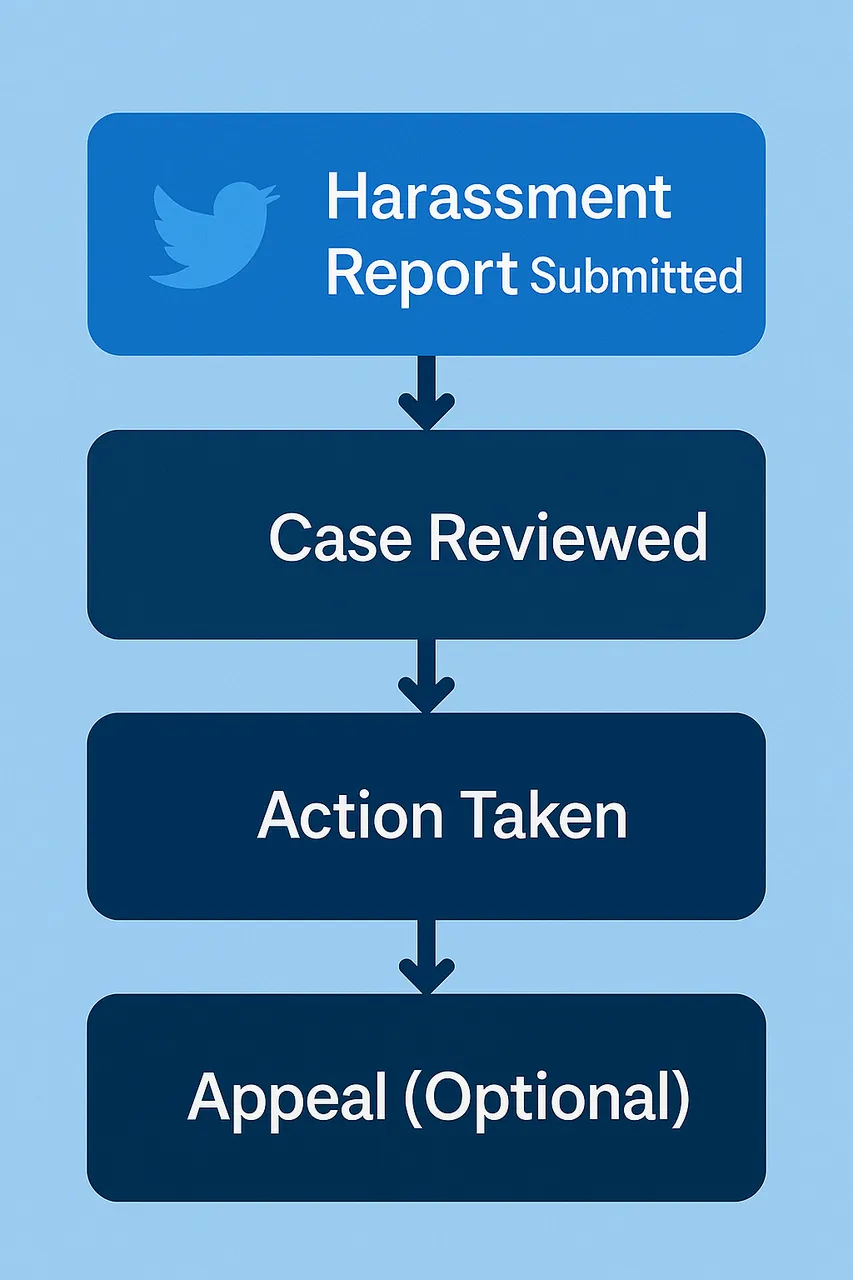
Withholding vs deletion — why your post "disappears" but isn't gone
That distinction matters. X marks the post as hidden under DMCA but does not erase the URL or post ID. If the user wins a counter-notice or the rights holder later retracts, withholding reverses cleanly. Hard deletion happens only at account suspension (everything goes) or when X enforces against an account whose primary purpose was infringement. Knowing the difference helps when you're filing again on the same account — your prior notice is still on file even though the visible post is hidden.
Counter-notices and the 10–14 business day clock
The infringer can file a counter-notice through X's Help Center. Under § 512(g) of the DMCA, if a valid counter-notice is filed, X must wait between 10 and 14 business days before potentially restoring the content. During that window, the original complainant can file a federal lawsuit to keep the content down. Without a lawsuit, the content is reinstated when the clock runs out. A valid counter-notice must contain six § 512(g)(3) elements — the user's identification of the material, contact details, a statement under penalty of perjury that they have a good-faith belief the removal was a mistake, and consent to US federal court jurisdiction. The last element is what makes a counter-notice a legal commitment, not a casual reply.
§ 512(h) subpoena — unmasking anonymous infringers
For serious cases — coordinated piracy, organised brand fraud, criminal stalking — there is a third procedural lever most Twitter takedown guides skip. 17 U.S.C. § 512(h) lets a copyright owner obtain a subpoena from any federal district court clerk requiring an online service provider to identify a specific infringer. The package is your original takedown notice copy, a proposed subpoena, and a sworn declaration that the information will be used only to protect the copyright. X must disclose the user's identifying information promptly upon proper service. We use § 512(h) when a Twitter account takedown alone won't stop the harm and civil or criminal action against the human behind the account is the next step.
Realistic expectations after a Twitter takedown
A few notes from cases we've handled. Withheld content reappears constantly from new accounts; that is the whack-a-mole reality of any platform-level enforcement, not a failure of the DMCA. Every new copy needs a new notice. And reposting material already removed under a DMCA notice can — per X's own warning — lead to permanent suspension on its own, which is why repeat infringers eventually run out of accounts even without a single account-level filing.
How to read a Twitter DMCA takedown notice you've received
If your post was withheld and you've received an email from X about a DMCA complaint, here is how to read twitter dmca takedown notice emails without panic. The notice identifies four things you need to find: the original work claimed, the specific post URLs withheld, the reporter's contact details, and instructions for either filing a counter-notice or requesting retraction.
Three options after you receive a Twitter DMCA takedown notice
Before you do anything, answer three questions honestly. Did you in fact use the work the reporter claims? Do you have a real fair-use defence (commentary, criticism, parody, education) or a licence? Is the reporter actually the rights holder? "I'm in the photo" doesn't make you the copyright holder — under US law the photographer almost always is.
You have three options. Do nothing, in which case the post stays withheld and any account-level consequences follow on. Ask the reporter to retract — X's policy notes you can request a retraction via the form linked in your notice email, and reporters do sometimes withdraw when contacted reasonably. Or file a counter-notice through X's Help Center, which forwards your full contact info to the reporter and consents to US federal court jurisdiction. False counter-notices carry the same § 512(f) liability as false notices.
Suing the reporter back under § 512(f) misrepresentation
The DMCA cuts both ways. 17 U.S.C. § 512(f) lets the target of an abusive DMCA notice sue the reporter for damages — including legal fees — if the notice was filed with knowledge it was false. Case law: in Online Policy Group v. Diebold (2004), a court found that voting-machine company Diebold had no reasonable belief its leaked internal emails were copyrighted, and Diebold settled for $125,000 in damages and fees. More recently, Lenz v. Universal Music (the "dancing baby" case) confirmed that copyright holders must consider fair use before filing — failing to do so is grounds for § 512(f) liability. If you've received a Twitter DMCA takedown notice you believe was filed in bad faith, document everything; a § 512(f) claim has teeth.
What a DMCA retraction looks like and when to ask for one
A retraction is the reporter's voluntary withdrawal of the notice. It restores your content faster than a counter-notice and avoids the federal-jurisdiction commitment. Per X's policy, a retraction must (1) identify the material that was disabled and (2) explicitly state the reporter wants to retract the notice. Either side can send the retraction to X's copyright team for processing; the route is the fastest way to undo a Twitter account takedown that both parties agree was filed in error.
"Twitter takedowns" that aren't legal takedowns — a short disambiguation
A search for twitter takedown in 2026 returns three different families of results: legal removals (this guide), platform enforcement actions (Trump 2021), and rhetorical or political uses (Tesla Takedown protests, "epic" clapbacks, podcast names). Only the first uses the DMCA, impersonation, trademark, or DSA mechanisms a Twitter account takedown actually relies on.
| What people often mean | What it actually is | Does this guide help? |
|---|---|---|
| A DMCA copyright removal | The legal process described above | Yes — this is the guide |
| Reporting an impersonator | X's impersonation form | Yes — see route #2 |
| The 2025 "Tesla Takedown" protest movement | A public protest campaign organised on X — not an account removal | No. This guide is about removals, not protests |
| "Donald Trump Twitter takedown" / "doland trump twitter takedown" | Trump's January 2021 platform-initiated suspension, reversed by X's new ownership in November 2022 | No. That was X enforcing its own rules, not a user-filed notice |
| "Epic Rowling Twitter takedowns" / "fiery twitter takedowns" / "hot takedown twitter" | Rhetorical clapbacks and sports commentary — the FiveThirtyEight "Hot Takedown" basketball podcast archive falls here | No. Words, not removals |
| "Elite takedown club twitter" | An X account, not a process | No |
When "Twitter takedown" means a protest, ban, or rhetoric
The point isn't to dismiss those searches — they reflect real interest. But none of them is the legal instrument this guide covers, and none of them is something we work on. The Tesla Takedown movement, for instance, organises lawful protest activity on X and elsewhere; it does not file DMCA notices. The 2021 Donald Trump suspension was a platform-initiated enforcement against an account, reversed by X's new ownership in November 2022 — neither end of that story used the user-filed process this guide describes. The "Hot Takedown" podcast is a FiveThirtyEight basketball archive. "Elite Takedown Club" is an X account. None of these is a Twitter account takedown in the sense rights holders mean it.
What we will and won't do (and why no one guarantees outcomes)
YourBanGuy handles Twitter account takedowns on X — copyright, impersonation, trademark, and DSA — alongside the equivalent work across Instagram, TikTok, and Telegram. We file as your authorised agent so X forwards our contact details, not your home address. We do not guarantee outcomes; no honest operator can.
Our team at YourBanGuy handles copyright and IP takedowns on X, alongside impersonation removal and ongoing brand protection for creators and businesses. We track the full review-and-counter-notice window so nothing falls through. We do the same job across Instagram, TikTok, and Telegram.
What we will not file
We will not file a DMCA against content that isn't yours. We will not file an impersonation report against a critic, satirist, or competitor whose only "offence" is being unwelcome. We will not take work that asks us to mass-report an X account — we explain why we don't do that on the linked guide. And we will never ask for your password or two-factor codes; no legitimate platform Twitter account takedown process requires them.
Why "guaranteed Twitter takedown" services are a red flag
No honest operator can guarantee a Twitter takedown. The decision sits with X under its own rules and the law. What an experienced filer changes is the input — a compliant notice, the right route, the evidence X actually wants, and the follow-up if the first attempt is bounced. Operators who claim 100% removal rates either cherry-pick easy cases, misrepresent their results, or use methods that get the filer sanctioned under § 512(f). That is why our dmca takedown service twitter offer comes with an honest pre-assessment, not a money-back guarantee.
Frequently asked questions
Does X usually take down copyright-infringing posts within three business days?
Most complete, compliant DMCA notices on X are reviewed within three business days, based on platform documentation and recent guides. Speed depends on whether your notice includes the six statutory requirements, direct tweet URLs (not just a profile link), and proof you own the original work. Incomplete notices are bounced back, which restarts the clock.
Can you request a takedown of a Twitter account, or only individual posts?
You can request a Twitter account takedown when an account exists primarily to infringe — for example, a clone of you, a scam impersonator, or a serial copyright thief. Most filings start at post level; account-level suspension follows under X's repeat-infringer rule, which industry guides describe as roughly six valid copyright strikes before permanent removal.
How do I read a Twitter DMCA takedown notice I received?
The notice email from X identifies the original work claimed, the specific post URLs withheld, and the reporter's contact details. Confirm your post truly used that work, whether fair use applies, and whether the reporter is the genuine rights holder. You can ignore it, ask the reporter for retraction, or file a counter-notice — each route has different legal consequences.
What is the EU DSA route, and when should I use it instead of DMCA?
The Digital Services Act gives EU users a separate flagging route for illegal content under their national law — not just copyright. Use it when the issue is broader than US copyright: harassment that breaks local law, illegal goods, or content already removable in your country. If your case is purely copyright, DMCA is still the faster lane on X.
Will X share my contact info with the person I reported?
Yes. X's own copyright policy states that when it acts on a valid DMCA notice, it forwards a full copy — including your name, address, phone, and email — to the user who posted the content. That is why X explicitly suggests appointing an agent if you prefer privacy. Many creators discover this only after their home address has already been disclosed.
How is a DMCA takedown service for Twitter different from filing it yourself?
A DMCA takedown service for Twitter files on your behalf as the designated agent, so X forwards the service's contact details — not your home address — to the alleged infringer. A good service also vets the claim against fair use, builds the evidence pack, tracks the three-day review window, and escalates if the notice is bounced. The legal exposure under section 512(f) remains yours.
Are the Tesla Takedown protests or Donald Trump's 2021 ban the same kind of Twitter takedown?
No. The 2025 Tesla Takedown protest movement organises on X but does not remove accounts; it is public organising. The 2021 Donald Trump suspension was a platform-initiated enforcement action, not a user-filed takedown, and was reversed in November 2022. Both turn up in searches for Twitter takedown but neither uses the DMCA, impersonation, trademark, or DSA route this guide covers.
Do you guarantee a Twitter takedown? What is a realistic outcome?
No, and you should be wary of anyone who does. Every takedown depends on X's own review under DMCA, its rules, or the DSA. What we can promise is preparation: a compliant notice, the right route, an evidence pack X will actually action, and follow-through if the first attempt is bounced. We tell you honestly when we think a case will not succeed.
Are Twitter and X the same platform for takedown purposes?
Yes. Elon Musk rebranded Twitter to X in July 2023, but the legal entity, the DMCA-designated agent on file with the US Copyright Office, the impersonation policy, and the EU DSA designation all carried over. A Twitter account takedown and an X account takedown are the same legal instrument, filed at the same help.x.com forms. Search engines treat the names as synonyms.
Can I file a Twitter copyright takedown if I am outside the United States?
Yes. The DMCA is US law, but it applies to X because X is a US-headquartered platform claiming section 512 safe harbour. Non-US rights holders file using the same form. EU users have a parallel route under the Digital Services Act for content illegal under their national law. UK users can file under both DMCA and the UK Online Safety Act where applicable; many cases benefit from filing both.