Instagram Mass Report Bot: Why They Fail in 2026
An Instagram mass report bot is a script or paid Telegram service that submits many automated reports against one account. In 2026, these bots don't work the way they're sold — Meta's Inauthentic Behavior policy actively reverses coordinated mass-reports, and the legitimate path is one well-evidenced report through the right official form.
Targeted on Instagram and need it gone?
Bot reports won't fix this — send us the profile and proof you're being harmed, and we'll prepare the takedown through Meta's official channels.
We never ask for passwords · Legitimate owners & genuine victims only · No guaranteed outcomes
Instagram mass report bots — whether GitHub scripts, paid Telegram services, or sites promising 92% success rates — don't work in 2026. Meta detects coordinated reporting and reverses it, while a single well-evidenced report through the correct official form outperforms thousands of bot submissions.
- What is an Instagram mass report bot, really?
- Do mass reporting Instagram bot tools actually work in 2026?
- Where these bots come from: GitHub, Telegram, Reddit, and "online" sites
- How Meta's 2026 moderation actually treats coordinated reports
- The official channels that replace any Instagram mass reporting bot
- The evidence pack one real report needs (that no bot can supply)
- Four red flags of a mass report bot Instagram website
- When professional Instagram takedown help is worth the cost
What is an Instagram mass report bot, really?
An Instagram mass report bot is automation software — most commonly a Python script from GitHub, a paid Telegram bot service, or a "mass instagram report bot" website — that submits a high volume of reports against a single account or post. The promise is that volume forces moderation. The reality, after two years of Meta tightening its anti-abuse models, is more complicated.
You'll find roughly three flavours in the wild. The first is open-source code on GitHub or GitLab — scripts that ask you to install Python dependencies and run a browser-automation library to spam Instagram's in-app report flow. The second is a Telegram-driven service: you message a bot, pay in crypto, and a backend account farm files the reports against your target. The third is a polished website that markets the same thing with stock images, fake testimonials, and bold "X% success rate" claims.
All three sell the same idea: enough reports against one profile and Instagram's moderators will pull it. The mechanism most users picture — a counter ticking up until a human takes notice — doesn't match how Meta moderates Instagram today.
Do mass reporting Instagram bot tools actually work in 2026?
No, and Meta's own published policies say so. In 2026, Instagram's moderation systems weight evidence quality and report categorisation far higher than report volume, and the Inauthentic Behavior policy explicitly targets coordinated abuse of the reporting system. Anyone running a mass reporting instagram bot in 2026 faces three real risks before the target account sees any consequence.
The first risk is dilution. Bot reports rarely include real evidence — no screenshots, no URLs of the violating posts, no statement of who is being harmed. Meta's internal triage routes thin reports to automated review where they are closed in seconds. A mass report bot instagram campaign that produces 5,000 thin reports is functionally identical to one report with no evidence.
The second risk is detection. Meta describes its Inauthentic Behavior policy as removing "adversarial networks that coordinate to abuse our reporting systems." In their Q4 2022 Adversarial Threat Report, they spell it out: coordinated mass-reporting is treated as a hostile network operation, not a moderation signal. Detected campaigns get reversed and the reporter accounts removed.
The third risk is the boomerang. The EU's Digital Services Act, in force across all 27 member states, lets hosting platforms suspend users who "frequently submit notices that are manifestly unfounded" (DSA Article 23). A paid bot campaign that ploughs thousands of unfounded notices into Meta is exactly the behaviour Article 23 was written to deter.
The gap between bot promise and Meta reality is wide enough to be tabulated:
| What the bot ad promises | What Meta actually does |
|---|---|
| "92% success rate, 24–72 hour ban" | No platform commits to either; rates are unverifiable |
| "Coordinated reports force escalation" | Coordinated reports are detected, then weighted down or reversed |
| "Bots use real accounts so it's safe" | Real-account farms are the textbook Inauthentic Behavior signal |
| "Volume gets human review" | Volume from one network gets one flag — not many reviewers |
| "Refund if no ban" | Anonymous Telegram operators don't honour refunds |
Where these bots come from: GitHub, Telegram, Reddit, and "online" sites
The "instagram mass report bot" SERP is dominated by four kinds of source, and each carries its own failure mode. Knowing where a tool actually lives makes the risk visible before you click install or pay.
"Instagram mass report bot github" repos
GitHub and GitLab host dozens of repositories under topics like instagram-mass-report-bot-pow, instagram-reporter-bot-mas, and the hyphenated instagram-mass report bot github variants. The most upvoted ones — Khanejo/Instagram-mass-reporter, securityuniverse/instasec — are typically a thin layer of Selenium or PyAutoGUI on top of Instagram's web interface, written years ago and maintained sporadically. Three problems repeat: (a) the selectors break when Instagram redesigns the report dialog, which now happens every few months; (b) several flagged repos quietly include credential-stealers or clipboard hijackers in dependencies; (c) when the script does run, it fingerprints your IP and Instagram account into Meta's anti-abuse models for future bans.
"Instagram mass report bot telegram" services
Search "instagram mass report bot telegram" and you'll land on channels like @bestrepbot or copycats that brand themselves as "the world's #1 mass report bot." The pattern is uniform: pay in TON or USDT, send a target link, wait. There is no platform of record, no real customer service, and no recourse when nothing happens. The channels routinely rebrand under new handles after complaint volume builds, which is why you'll see "world's #1" duplicated across half a dozen near-identical Telegram bios.
"Instagram mass report bot reddit" threads
Most r/Instagram and r/scams threads about an instagram mass report bot reddit search end the same way: the user paid, the target stayed up, or the reporter's own Instagram got flagged. These threads are useful — as a warning signal, not a buyer's guide. Treat Reddit as a place to read post-purchase regret, not pre-purchase reviews.
"Instagram mass report bot online" websites
The polished sites are the trickiest because they look professional. Common tells: a banner success rate above 90%, dashboard screenshots that are clearly mocked up, "2,200+ cases handled" with no named cases, refund language that quietly excludes "platform decision," and a Telegram-only contact button at the end of the funnel. These are the same Telegram operators with a WordPress theme on top.
How Meta's 2026 moderation actually treats coordinated reports
Meta's moderation moved heavily toward AI-led triage during the 2025–2026 enforcement cycle, which changed how any mass report instagram bot is processed. Reports now pass through an automated classifier before they ever reach a human reviewer, and the classifier is built specifically to deprioritise the patterns bots produce.
Three concrete behaviours matter for anyone planning a takedown. One: identical reports from many accounts cluster as a single "report event" — they don't multiply. Two: reports that don't specify a Community Guidelines section get routed to background queues where automated systems alone decide, and those systems heavily favour the status quo. Three: reports from accounts with no follower graph, no posts, or matching device fingerprints are downweighted as inauthentic before they're read.
The 2025–2026 ban wave is the other side of this same machine. Independent reporting documented thousands of innocent Instagram users being suspended by the new AI moderation in mid-2025, including Meta Verified subscribers. Investigative work by AlgorithmWatch earlier in the cycle had already shown how mass-reporting networks operated as criminal harassment infrastructure. Meta's response — more aggressive automated enforcement on both reporters and targets — is the world a bot now operates in.
Got hit by the 2025–2026 ban wave instead? If your own legitimate account was suspended in the cycle, the recovery path is identity verification, not appeals theatre. Our walkthrough on how to recover a hacked Instagram account covers the video-selfie route and what to do when Meta has stopped responding.
The official channels that replace any Instagram mass reporting bot
Skip the instagram mass reporting bot entirely. One report through the right official Meta form, filed by the actual party harmed, outperforms any instagram mass reporter bot because it gives Meta what they need to act: a named complainant, a verifiable claim, and the specific Community Guidelines or legal basis that applies. Five channels cover almost every real case.
- Impersonation — the help.instagram.com impersonation form for accounts pretending to be you or your business. Meta only acts on impersonation reports from the person being impersonated (or a representative); a bot brigade from third parties is the wrong signal.
- Trademark and counterfeit — the trademark report form for brand misuse, fake stores, and scam ads using your marks. Pair with a brand-protection workflow for repeat offenders. Our brand protection service handles the ongoing monitoring side.
- Copyright — the copyright report form for stolen photos, videos, or written content. In the US, this is a formal DMCA notice; in the EU it slots into the Article 16 notice-and-action mechanism.
- Scam, fraud, and phishing — the in-app "report" flow under "scam or fraud," combined with off-platform reports to the FTC and IC3 in the US, or national fraud bodies and Europol in the EU. We cover the end-to-end path under scam & fraud reporting.
- Non-consensual intimate images — StopNCII.org for adults (hash-matching prevents re-uploads), NCMEC Take It Down for minors, plus Meta's in-app NCII flow. See intimate image removal for the supported path.
For impersonation specifically — the most common reason people end up searching for a bot — the YBG impersonation removal service is the ethical counterpart to what the bots claim to do, run through Meta's own forms with the evidence those forms require.
The evidence pack one real report needs (that no bot can supply)
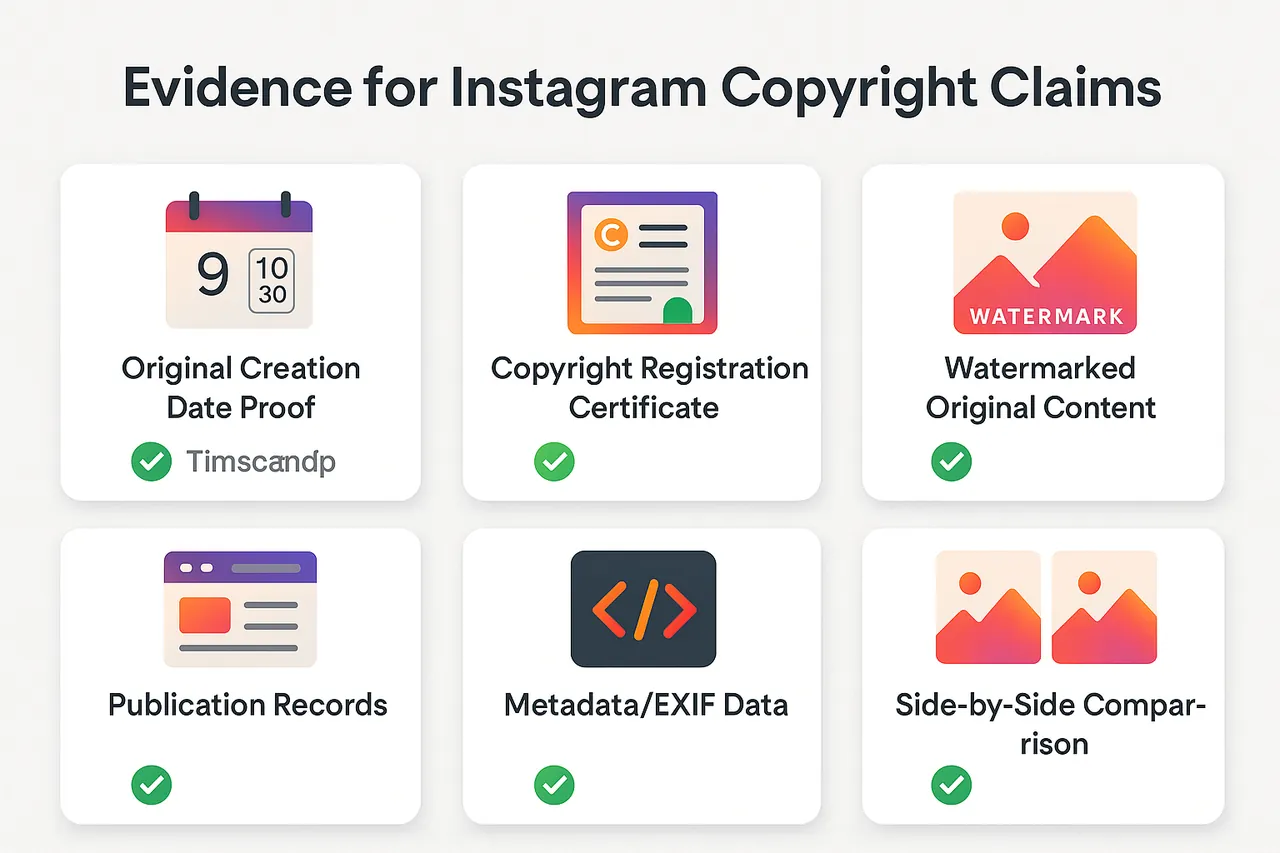
What a mass report instagram account bot cannot provide is the one thing Meta actually wants: a named, verifiable complainant with proof of harm. Every legitimate Instagram report is judged on the strength of its evidence, not the count of its filings. The pack below is what we send with every impersonation case, and it is what closes them.
- The exact URL of the violating profile or post — `instagram.com/username/` or a permalink. Not a screenshot of the URL; the live link.
- Government-issued photo ID in the name being impersonated. For a brand, articles of incorporation or a trademark certificate. Meta's reviewers need to match the claim to a real person or entity.
- Side-by-side screenshots showing the legitimate account next to the impersonator — same bio, same photos, near-identical username — with timestamps and visible URLs.
- A specific harm statement: scammed audience members, financial loss, reputational damage. "I don't like it" is not a harm; "they took $4,200 from my followers using my likeness" is.
- The correct Community Guidelines section: impersonation, fraud, IP, NCII, harassment. Picking the wrong category routes the case into the wrong queue and slows it down.
- For NCII, never the images themselves — use StopNCII's hash so the content stays on your device, not in a stranger's inbox. A legitimate takedown service will never ask you to send intimate images.
That's the instagram account mass report bot replacement: one filing, six pieces of evidence, the correct form. In cases we've handled since 2024, this pack typically resolves impersonation reports in 5–14 days for everyday accounts and 24–72 hours for verified or brand-owned ones — without any of the bot promises about success rates.
Four red flags of a mass report bot Instagram website
Most people searching for help on this topic just want to know which sites to avoid. After auditing the SERP, four red flags identify a mass report bot instagram website you should walk past — and they apply equally to a mass reporting bot instagram Telegram channel.
- Specific success rates above 90%. No platform publishes ban-success rates, and no operator has visibility into Meta's review queue. Numbers like "92% success" or "98% takedown" are marketing fiction. The honest answer is always "it depends on the evidence and the violation type."
- Asks for your Instagram password or session token. No legitimate service needs your login to report someone else's account. A site that asks for it is either harvesting credentials or planning to use your authenticated session in its bot farm — both of which get your account banned.
- Crypto-only payment plus Telegram-only contact. Pay-in-USDT-on-a-Telegram-bot is the signature of operations that don't expect to be around for a refund conversation. Legitimate vendors take cards, have a real domain, and reply on a channel you can name.
- No published terms, no named team, no business address. A real takedown operator — like us — is anonymous about its operators (for safety) but transparent about its scope, its limits, and what it won't do. A bot service is anonymous about everything.
When professional Instagram takedown help is worth the cost
If the violation is clear, the evidence is ready, and you're the named victim, you can usually file the report yourself through the links in the section above. Professional help earns its cost in three situations, and we'll tell you honestly which one you're in before you commit to anything.
The first is repeat impersonation — the bad actor keeps creating new accounts within hours of takedown. That needs a monitoring loop, not one report. The second is multi-platform abuse — the same scam moves between Instagram, X, TikTok, and Telegram. We cover the cross-platform side under sister guides for Twitter, TikTok, and X reporting. The third is NCII and serious harassment, where the evidence work is sensitive and the wrong filing can compound the harm.
If your case lives in any of those categories, a calm, evidence-led specialist beats both the DIY path and any bot. If it doesn't, do it yourself — the right form, the right evidence, one filing. Either way, no bot belongs in the process.
Frequently asked questions
Does an Instagram mass report bot actually get accounts banned in 2026?
Not reliably, and increasingly not at all. Meta's Inauthentic Behavior policy specifies that coordinated, automated reporting is treated as adversarial abuse — reports are weighted down, often reversed, and the bot operators' own accounts can be suspended. In cases we've handled since 2025, a single well-evidenced impersonation report consistently outperforms thousands of bot submissions.
Is there a working Instagram mass report bot Reddit users recommend?
Most r/Instagram and r/scams threads about an instagram mass report bot reddit search end the same way: the user paid, the target stayed up, or the reporter's own account got actioned. Reddit threads are useful as a warning signal, not as a buyer's guide. If a tool worked at scale, Meta would have shut down its account farms long before it reached a paid audience.
Will a mass report bot Instagram website refund the fee if nothing happens?
Almost never. A typical mass report bot instagram website takes payment in crypto, communicates only through Telegram, and disappears or blames Meta when the target stays online. There is no provider relationship, no contract, and no chargeback path. Treat any pre-payment to an anonymous Telegram channel as a donation you will not get back.
What's the safest replacement for a mass report Instagram account bot?
One properly filed report through Instagram's official form, with strong evidence. For impersonation, that's the help.instagram.com impersonation form with your government ID and proof of identity. For IP, the trademark or copyright form. For intimate images, StopNCII.org's hash-matching service plus the NCII path. A mass report instagram account bot adds risk, not signal.
Are Instagram mass reporter bot GitHub repos safe to download?
They carry three risks. First, many repos under topics like instagram-mass-report-bot-pow or instagram-reporter-bot-mas have been flagged for embedded credential-stealers and clipboard hijackers. Second, running them logs your IP and Meta account into a fingerprint Meta can later use to ban you. Third, even when clean, they don't work — the underlying tactic is what Meta detects, not the code quality.
How many reports does it actually take for Instagram to act on an account?
There is no magic number, and Meta has stated repeatedly that reports are weighted on quality and category, not volume. In our casework, one substantiated impersonation report from the legitimate party — with government ID and side-by-side evidence — triggers action faster than dozens of vague spam reports. The threshold isn't quantity, it's whether the reviewer has enough to act.
Can using a mass reporting bot Instagram service get my own account banned?
Yes. Meta's Inauthentic Behavior policy removes accounts that coordinate to abuse the reporting system, and the EU's Digital Services Act Article 23 lets platforms suspend users who frequently submit manifestly unfounded notices. If you authenticated a third-party bot with your own Instagram, you also handed it your session — a common path to compromise.
Can YourBanGuy run a mass report Instagram bot for a paying client?
No. We don't operate brigades, run mass-report bots, or take competitor-sabotage work. We help legitimate owners and genuine victims through Instagram's official channels — impersonation, copyright, trademark, scam, and NCII routes — with the evidence those channels require. We never ask for passwords and we never promise outcomes.