How to get someone banned on Instagram
To get someone banned on Instagram in 2026, you report the account through Instagram's in-app menu, the impersonation form, the copyright or trademark form, or the defamation form — depending on what they've actually done. Volume of reports does not decide the outcome. Evidence quality, the right form, and a clear violation do.
Need an offending Instagram account taken down?
If a real account is impersonating you, scamming people in your name, or sharing private images — message us with the profile URL and we'll route the report through Instagram's official channels.
We never ask for passwords · Legitimate owners & genuine victims only · No guaranteed outcomes
You can only get someone banned on Instagram when their account genuinely breaks Meta's rules — and the right report, filed through the matching form with strong evidence, is what triggers action. Volume of reports does not. "Instant ban" services are scams that often double back to extort the victim.
- How to get someone banned on Instagram — and why volume isn't the answer
- Can you get someone banned on Instagram fast — or instantly?
- What gets someone's Instagram banned: the real violations Meta acts on
- How to get someone banned from Instagram: the five official reporting paths
- What to include: the evidence pack that gets someone's Instagram profile banned
- How long does it take to get someone instantly banned on Instagram?
- Beyond Instagram: DMCA, DSA, GDPR and law-enforcement routes
- What we won't do — and what you should never pay for
How to get someone banned on Instagram — and why volume isn't the answer
To get someone banned on Instagram, file a single, well-evidenced report through the form that matches the actual violation: in-app reporting, impersonation, copyright or trademark, defamation, or NCII tools. Meta's reviewers — and its automated systems — weigh what the account did, not how many people reported it. One thorough complaint can be enough.
That's a different answer than most search results give you. Ad-driven "professional Instagram ban service" pages claim 92% success rates with $60 fees and 24-hour turnaround. The numbers behind Instagram's actual moderation tell a different story. Meta's standardised DSA transparency reporting shows platforms made over 9 billion content moderation decisions in the first half of 2025 alone — roughly 99% of them proactive, and only a small share driven by user reports (European Commission, 2025).
In other words, Instagram acts mostly on its own detection systems plus the subset of user reports that arrive with real evidence. Red Points, an enterprise brand-protection vendor that runs Instagram takedowns at scale, puts it plainly: there is no magic number of reports, and "one solid report can be enough." So "how to get someones Instagram banned" is the wrong frame. The right one is — do they actually break Instagram's rules, and have I filed it through the matching form?
Can you get someone banned on Instagram fast — or instantly?
Genuine fast bans happen for very specific violations: confirmed child-safety material, credible threats of violence, and clear large-scale spam. Almost everything else — even strong impersonation — takes hours to weeks of review. Services promising "how to get someone banned on Instagram fast" for a fixed fee are almost always scams that end up extorting the victim too.
The "ban-as-a-service" market has lived on underground forums for years. A Motherboard investigation reported by Tripwire tracked the standard method: clone the victim's profile picture and name onto a verified account, then file a bogus impersonation claim against the legitimate account. The same vendors often resurface days later as "unban specialists" — charging the same victim several thousand dollars to undo damage they themselves caused.
That ecosystem is why "how to get someone instantly banned on Instagram" is the wrong search. False reporting can also boomerang. Instagram's abuse-detection systems flag accounts that file repeated identical or clearly fabricated complaints, and your own profile can be restricted as a result. If the account harming you is real, the slower route is also the durable one — and our recovery guide covers the opposite case, where the ban-and-extort cycle has already hit you.
What gets someone's Instagram banned: the real violations Meta acts on
Meta acts on a defined list of Community Guidelines categories. Action ranges from content removal, to feature limits, to full account suspension, depending on severity and history. The categories that matter most in 2026 are impersonation, intellectual-property infringement, scam and fraud content, hate speech and threats, non-consensual intimate imagery, large-scale automation and spam, and child-safety violations.
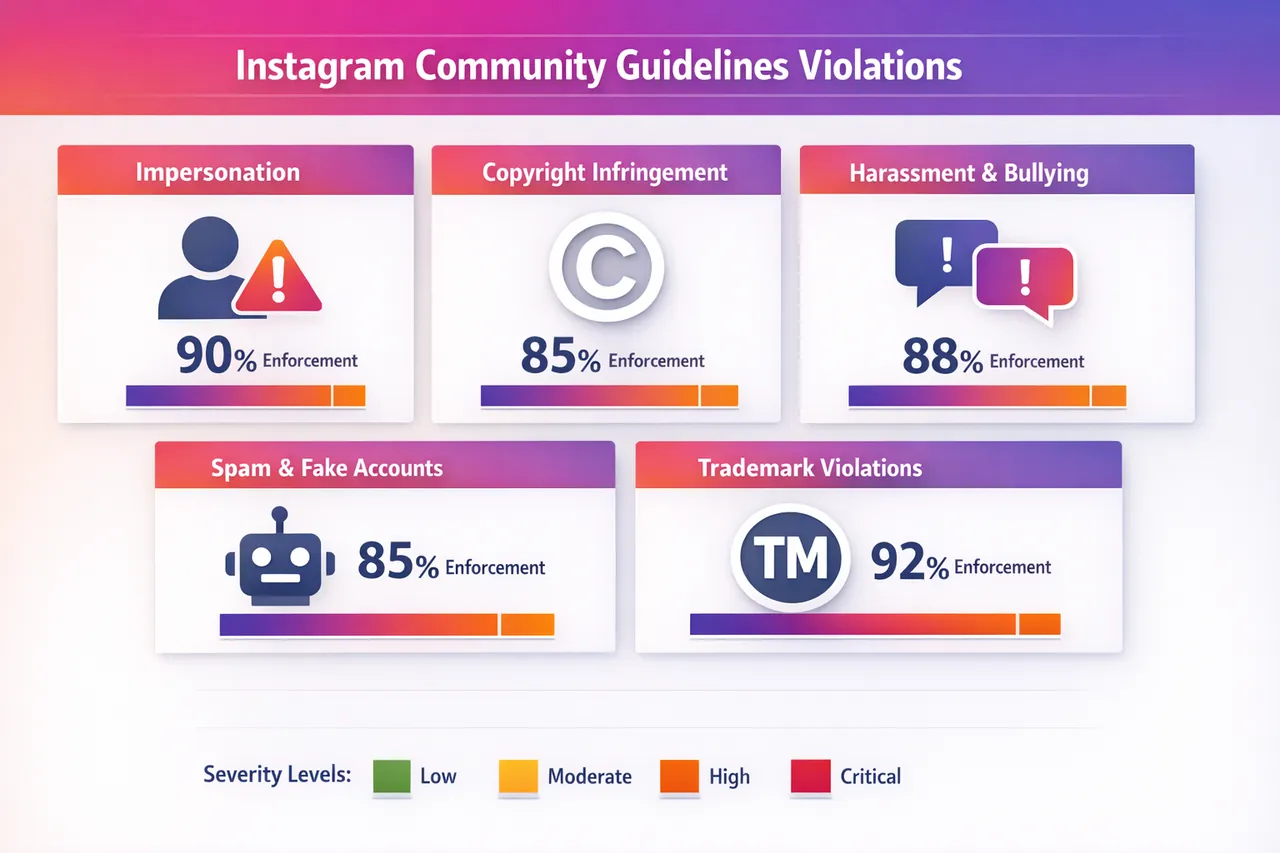
A few of these matter more than others when you're trying to get a real offending account removed:
- Impersonation. Pretending to be a real person or brand. Highest-yield path when it fits. Instagram has a dedicated form and an explicit policy — and we handle these through our impersonation removal workflow.
- Intellectual property. Stolen photos, videos, music, logos, or trademarked names. Reported through copyright or trademark forms — these are legal notices, not opinion polls. See our copyright takedown page for what valid notices require.
- Scams and fraud. Phishing DMs, fake shops, investment-scam funnels, romance fraud. Reported in-app on the offending post, profile or message — and via the scam & fraud reporting route when money has moved.
- Threats and harassment. Targeted abuse, doxxing, or violent threats. Most acted on quickly when the threat is explicit and screenshots are clear.
- Non-consensual intimate imagery (NCII). Instagram has a dedicated NCII flow, and trusted external tools — StopNCII.org and NCMEC Take It Down — generate hashes that block re-uploads. Our intimate image removal work routes through these.
- Automation and spam. Bot-driven likes, follows, comments, or mass-DM activity. Often catches the offender automatically, but a clean human report still helps.
"I disagree with their opinions," "I find this content annoying," or "competitor I dislike" are not on this list. Filing for those achieves nothing — and can put your own account at risk.
How to get someone banned from Instagram: the five official reporting paths
Instagram exposes five distinct enforcement routes, each routed to different reviewers. The wrong form is the most common reason a valid case gets ignored. Use this map to pick the right one before you file, and route each angle of the case separately if more than one applies.
- In-app report — open the profile or post, tap the three-dot menu, choose Report, and select the matching reason. The fastest path for clear abuse, harassment, scam content, or spam.
- Impersonation form — used when an account is pretending to be you, your child, or someone you represent. You'll be asked to upload a photo of yourself holding a government ID.
- Copyright report form — for stolen content. Equivalent to a DMCA notice. You'll provide URLs of the infringing posts, proof of ownership, and a signed statement under penalty of perjury.
- Trademark report form — for misuse of a registered mark in the username, bio, logos, or product listings. Requires the registration number and jurisdiction.
- Defamation reporting form — for content that makes factually false statements about you and causes harm. Only the injured party or a legal representative can file.
If the case has more than one angle — say, an impersonator who is also using your photos to run a scam — file each relevant form separately. The reports go to different teams, and stacking the angles raises the probability that at least one triggers review. This is how a working "how to get someone's account banned from Instagram" workflow runs in practice for legitimate victims, and the same logic underpins the deeper steps in our Instagram account takedown guide.
Stuck choosing the right form? If you can share the offending profile URL and a one-line description of what they're doing, we'll tell you which form to use — for free. Message us with the link and a screenshot of the most damaging post.
What to include: the evidence pack that gets someone's Instagram profile banned
Reviewers do not investigate. They confirm. That is why one strong report often beats fifty weak ones, and why the evidence pack you submit decides the outcome. Every legitimate report should arrive with the same five elements — preferably as a single PDF or a zipped folder of dated screenshots.
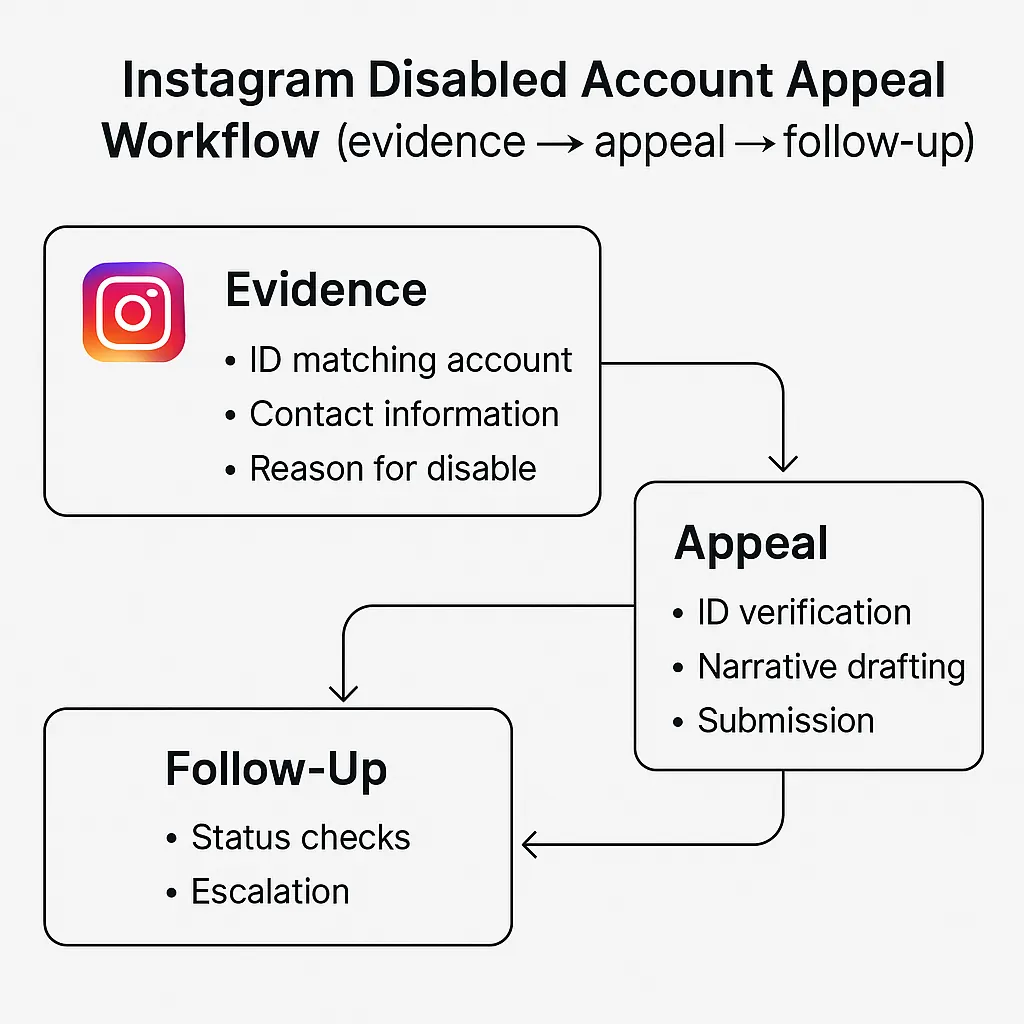
- The exact profile URL — full
https://www.instagram.com/<username>/, not just the handle. - Direct URLs for every offending post, story, reel, or DM — Instagram's reviewers act on specific pieces of content far more reliably than on vague "this whole account" complaints.
- Timestamped screenshots — full-screen, system clock visible, captured before the offender can delete. Multiple shots per piece of content beat a single crop.
- Proof of who you are or what you own — government ID (impersonation), trademark registration (IP), original camera-roll metadata (copyright), or a verifiable presence elsewhere that establishes you as the real person.
- A short factual narrative — three or four sentences in plain language: who the offender is pretending to be, what they did, what specific Community Guideline or law it breaks, and what harm has resulted (lost sales, scammed followers, reputational damage).
Skip the emotion. Reviewers see thousands of reports a day, and the ones that move are the ones that hand them a confirmable file — not a vent.
How long does it take to get someone instantly banned on Instagram?
"Instantly" is rare. In cases we've handled, child-safety and credible-threat reports often produce action within hours. Impersonation removals against accounts with weak evidence trails generally resolve in 24–72 hours. Copyright and trademark complaints with complete documentation typically move in one to seven days. Defamation and complex harassment cases can take one to four weeks, sometimes longer.
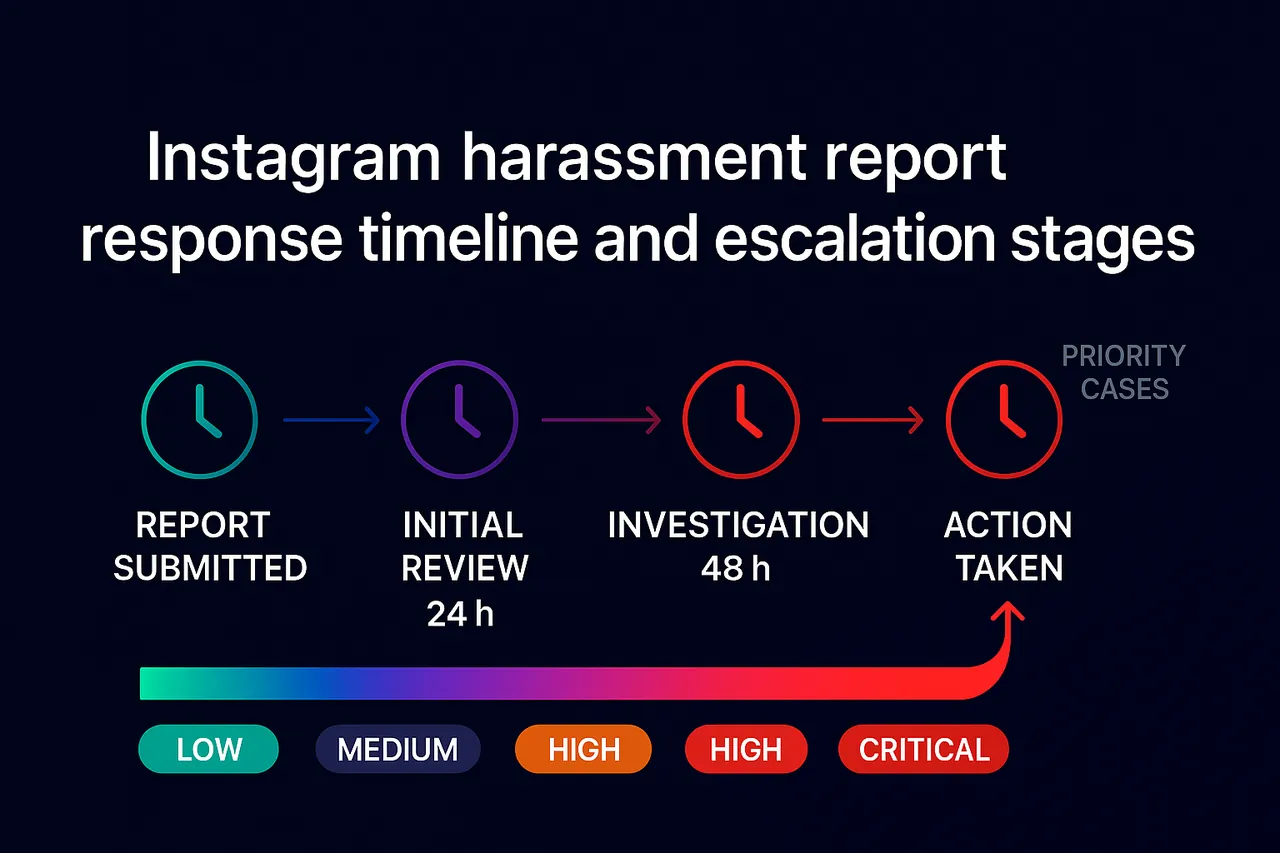
Two factors compress that timeline. The first is filing through the right form on the first try — every misrouted report adds days. The second is the offender's account history: a newly created clone with no followers and a single scam DM moves much faster than a year-old account with engagement and a clean history. Independent analyses note that Instagram now assigns accounts an internal trust score that strongly affects how quickly reports against them are actioned.
If the EU is your jurisdiction, you can also lean on the DSA. Under Article 17, Meta must give a "statement of reasons" when content is removed or restricted — so you get a written explanation of the outcome, not just silence.
Beyond Instagram: DMCA, DSA, GDPR and law-enforcement routes
For serious cases, Instagram is one channel — not the only one. Real progress often comes from running platform reports in parallel with legal and law-enforcement complaints. These routes are how you actually get someone's account banned from Instagram when the in-app pipeline stalls.
- United States. File scam and fraud reports with the FTC at reportfraud.ftc.gov and with the FBI's IC3. Copyright owners can issue a DMCA notice directly via Meta's IP portal; meritless counter-notices weaken the offender's standing across every future Meta product.
- European Union. Submit a GDPR right-to-erasure request when the abuse involves your personal data or images, escalate to your national Data Protection Authority if Meta does not respond within 30 days, and report criminal activity to Europol or your national cybercrime unit. The DSA's Article 16 notice-and-action mechanism gives every EU user a formal channel for illegal-content complaints.
- Trusted flaggers. Over 60 trusted-flagger organisations are now appointed across the EU, with priority routing into platforms — especially for child safety, scams, and terrorist content. If your case fits, an aligned NGO can sometimes move a report further than a private user can.
- Brand-side monitoring. If your brand is being cloned repeatedly across handles, the durable answer is continuous detection rather than one-off reports — which is what our brand protection retainer covers.
None of these guarantee a ban. They do, however, create paper trails platforms find harder to ignore, especially when multiple routes confirm the same factual claim.
What we won't do — and what you should never pay for
We do not file false reports, run mass-reporting brigades, or operate "ban services" against accounts that haven't actually broken the rules. We don't take competitor-sabotage work. We don't ask for your password or your two-factor codes — no legitimate recovery or takedown specialist ever does. And we don't promise guaranteed outcomes, because every decision rests with the platform's own review (see the principles on our about page).
If you find anyone offering "guaranteed instant Instagram bans" for a flat fee — or someone reaching out unprompted offering to ban a rival or unban you for cash — assume it's a scam. The same operators frequently run both sides of the trade, banning the target with a bogus impersonation report and then charging the victim thousands to undo their own work. Tripwire and ExpressVPN have both documented this pattern over multiple years.
The honest workflow is slower, narrower, and more reliable. If a real account is genuinely impersonating, scamming, or harassing you — or violating your IP — there's a defined route, and we can prepare the report with you through Meta's own channels. Through account recovery or impersonation removal, what you pay for is preparation and routing, not a guarantee.
Frequently asked questions
How to get someone banned on Instagram immediately — does that ever work?
Immediate bans only happen when Instagram's systems instantly flag the content — typically child-safety material, credible threats of violence, or large-scale automated spam. For everything else, even with a perfect report, review takes hours to weeks. Anyone promising "how to get someone banned on Instagram immediately" for a fee is selling something Meta's actual moderation pipeline does not deliver.
How many reports does it take to get someone's Instagram banned?
There is no fixed number. Red Points and other brand-protection sources note that "one solid report can be enough" when the evidence is strong and the form matches the violation. Filing the same weak complaint twenty times will not move Meta's pipeline, and rapid identical reports can flag your own account for abuse instead.
What about Reddit threads on how to get someone's Instagram banned?
Most Reddit threads on "how to get someone's Instagram banned" or "how to get someone banned on Instagram reddit" recycle three things: pay a vendor, mass-report from burner accounts, or file false self-harm content reports. The first is scam economy, the second often backfires on the reporter, and the third is fraud Meta now actively detects. None are durable strategies for legitimate cases.
How do I get someone account banned on Instagram if they're harassing me but not impersonating?
Open the harassing profile, tap the three-dot menu, choose Report → Something else → Bullying or harassment, and follow the prompts. Then file a second report on every individual abusive post, DM or comment using the same path. Save screenshots with visible timestamps. If threats escalate, take the case to the police, IC3 in the US, or your national cybercrime unit in the EU.
How can I get someone Instagram banned for a scam DM?
Use the in-app report on the scam message itself: tap the message, choose Report → Scam, fraud or spam. Also report the profile via the three-dot menu, and screenshot every part of the exchange. If money or personal data changed hands, file with the FTC at reportfraud.ftc.gov in the US or your national fraud agency, and notify your bank. The financial trail is often what gets the account terminated.
Will the person know I reported them?
No. Instagram's reporting flow is anonymous — the account you report will not see your identity, and Meta confirms this in its Help Centre. The only exception is intellectual-property complaints such as DMCA or trademark notices: those are legal notices, and the reported party is told who filed the claim. If retaliation is a real risk in your case, route a DMCA report through a lawyer or agent.
What if Instagram rejects the report?
You have three levers. First, refile through a different category — for example switch a harassment complaint to a defamation form if the account makes factually false claims about you. Second, request a Statement of Reasons under DSA Article 17 if you're in the EU. Third, escalate offline: police, IC3, an FTC complaint, a GDPR erasure request or a lawyer's letter often does what the in-app flow won't.